 UnitBasse
Getting started
Starting bass:
12 common mistakes and how to fix them
Most beginner mistakes come from three things: too much force, not enough consistency, and forgetting about silence. Each one is fixed with a short exercise, done a little every day.
- Too much force in the fretting hand
- Plucking too hard
- Letting the other strings ring
- Not stopping your notes
- Playing without a metronome
- Going too fast too soon
- Watching your hands all the time
- Not knowing where the notes are
- Rarely tuning
- Never playing with others
- Learning without understanding harmony
- Practicing for hours, once a week
1Too much force in the fretting hand
What you do. You squeeze the string hard to make sure the note sounds.
Why it’s a problem. Your hand tires quickly, a string pressed too hard goes sharp, and over time it can hurt.
The fix. Just enough pressure: enough for the note to ring clean, no more. And it’s the weight of your arm doing the work, not your thumb squeezing.
The exercise (2 minutes). Hold one note. Ease off little by little until it buzzes, then come back just a touch above that. Repeat with each finger.
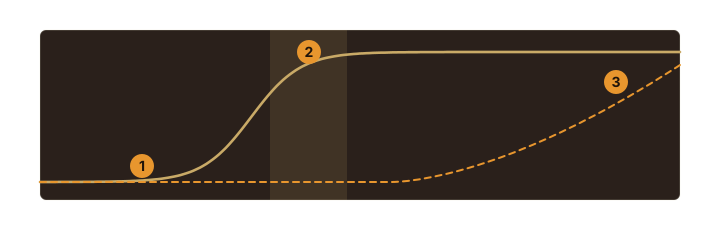
- Too little force: the note buzzes.
- Just the right pressure: just above the point where the note rings clean.
- Beyond that, the note gets no better, but fatigue builds, and a string pressed too hard sounds sharp.
2Plucking the strings too hard
What you do. You pluck hard to get volume.
Why it’s a problem. The string buzzes on the frets, the sound gets clacky, and the volume jumps around from one note to the next.
The fix. Let the amp do the volume. Turn it up instead of digging in harder: your dynamics then come from your hand, and the tone stays full. In UnitBasse’s amp, that’s the MASTER knob, the overall volume; GAIN drives the saturation.
The exercise (2 minutes). A simple line played very softly, then normally, keeping the same tone. Then the other way around.
3Letting the strings you’re not playing ring
What you do. You play one string, and the others ring along with it.
Why it’s a problem. That’s the “muddy” beginner sound. Open strings vibrate in sympathy and muddy everything.
The fix. Muting with both hands. Your plucking-hand thumb rests on the strings lower than the one you’re playing. Your fretting-hand fingers lightly touch the higher strings, without pressing them down.
The exercise (3 minutes). Play the G string, then D, then A, then E. Each time, check that the others stay quiet.
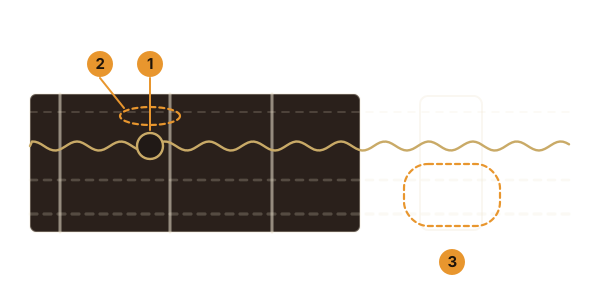
- The finger playing the note, on the D string.
- A fretting-hand finger lightly touches the G string, which is higher.
- The plucking-hand thumb covers the A and E strings, which are lower.
4Not stopping your notes
What you do. You let each note ring until the next one, or past it.
Why it’s a problem. A note that rings over the next one blurs the harmony. Silence is part of the groove: a short note, cut at the right moment, gives the line its drive.
The fix. To stop a note, release the fretting-hand pressure without leaving the string. For an open string, lay a finger on it.
The exercise (2 minutes). Four quarter notes, then four very short quarter notes, then four half notes, cutting off cleanly each time right on the planned beat.
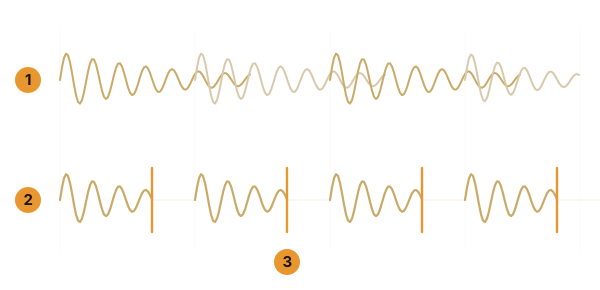
- The notes ring on and overlap: the sound is muddy.
- The notes are cut off cleanly: you hear each one.
- The moment the fretting hand releases the string.
5Playing without a metronome
What you do. You play “by feel”, with no tempo reference.
Why it’s a problem. Without noticing, you speed up in the easy parts and slow down in the hard ones. And holding the tempo is a bass player’s first job.
The fix. Practice everything with a metronome, slowly at first. In UnitBasse, it goes from 30 to 300 BPM, with Tap Tempo, and stays within reach in every tab, except BackTrack, which has its own.
The exercise (3 minutes). A scale at 60 BPM, one note per click. Then two notes per click, at the same tempo.
6Going too fast too soon
What you do. You play a passage at the song’s tempo right away.
Why it’s a problem. You repeat your mistakes at high speed, and those are what your fingers remember.
The fix. Find the tempo where you play it with no mistakes. Only go up 5 BPM once it has become easy: that’s what the −5 and +5 buttons on UnitBasse’s metronome do.
The exercise. For each hard passage, write down the tempo you reached with no mistakes, and the date. You’ll see your progress from one week to the next.
7Watching your hands all the time
What you do. Head bent over the neck, from start to finish.
Why it’s a problem. Your neck gets tired, and you can no longer read the music or watch the other musicians.
The fix. Learn the landmarks on the neck: the markers at frets 3, 5, 7, 9 and 12. Then play what you already know with your eyes closed.
The exercise (2 minutes). A scale you know, once while watching, once with your eyes closed.
8Not knowing where the notes are
What you do. You learn shapes and fret numbers, without knowing which notes you’re playing.
Why it’s a problem. You get stuck as soon as a song changes key, and you can’t come up with your own line.
The fix. Know the open-string notes: E, A, D, G. Then the ones at the 5th fret, which give you the next open string. Then the ones at the 12th fret, which give you the octave of the open string. In UnitBasse, the fretboard in the Scales tab shows your choice of Notes, Intervals or Diatonic Degrees.
The exercise (3 minutes). Pick a note, say C, and find it on every string.
9Rarely tuning, or only by ear
What you do. You tune up “when it sounds off”.
Why it’s a problem. You get used to an out-of-tune sound, and you play out of tune with others.
The fix. Tune before every session, with a tuner. Always come up to the note: if you overshoot, go down a little and come back up. UnitBasse’s Tuner works as a needle or a strobe, accurate to the cent.
10Never playing with others
What you do. You always practice alone, with no drums or chords.
Why it’s a problem. The bass is made to play with drums and chords. On its own, it doesn’t learn to listen: locking in with the kick drum, laying the root under the chord.
The fix. Play along with drums, then with a band, as early as you can. A recorded backing already does the job. In UnitBasse, BackTrack gives you a rhythm section played by real musicians, in 16 styles.
The exercise (5 minutes). Over a simple drum beat, play only the root, on every beat, listening to the kick drum.
11Learning songs without understanding the harmony
What you do. You learn lines by heart, note after note.
Why it’s a problem. You don’t know why the line works, or how to come up with your own.
The fix. For each chord, know where its root, third and fifth are. Most lines are built from them. In UnitBasse, the Harmony block in the Scales tab shows the chords of the scale, the triads and the arpeggios on the fretboard.
The exercise (3 minutes). Over two chords, say C then A minor, play root, third, fifth, then come back down.
12Practicing for hours, once a week
What you do. Two hours on Sunday, nothing the rest of the week.
Why it’s a problem. Fingers and memory learn through repetition. One long, isolated session is quickly forgotten, and it tires your hands.
The fix. Fifteen to twenty minutes a day beat two hours on Sunday. Always in the same order: warm-up, technique, scales, rhythm, then playing for fun.
This advice is common sense, not medical advice. If pain doesn’t go away, see a health professional.
Frequently asked questions
How long does it take to play bass well?
It depends on what you call playing well, and how much time you put in. With a little practice every day, many beginners can hold a simple line in time with other musicians after a few months. After that, you keep improving your whole life: that’s what makes the instrument so exciting.
How long should I practice each day?
Fifteen to twenty minutes a day beat two hours once a week. Fingers and memory learn through repetition. On days when you have more time, keep the same practice order and make each part longer.
Do I need to learn to read music?
You don’t need it to get started: tab is enough to know where to put your fingers. But reading rhythm and knowing the note names open a lot of doors, for playing with others and writing your own lines. You can learn it bit by bit, as you play.
Do I need a teacher?
It’s not required, but a few lessons at the start help a lot: a teacher spots bad posture or a tiring movement right away, before it becomes a habit. After that, you can carry on alone and go back to see them from time to time.
Why does my bass sound muddy?
Most often for three reasons: strings ringing when you’re not playing them, notes ringing over the next one, and plucking too hard so the strings buzz. Muting with both hands and cutting notes off at the right moment fix most of it. If the problem remains, have your bass’s setup checked.