 UnitBasse
Posture
How to hold your bass:
good posture, sitting and standing
The bass comes to you, you don’t go to it. Your back stays straight, your shoulders low. Your fretting hand doesn’t squeeze the neck: the weight of your arm does the pressing. Sitting or standing, the bass sits at the same height against your body.
Why posture matters
Bad posture tires you out before it hurts. You play for less time, and less in tune.
A movement you repeat thousands of times becomes a reflex. It might as well be the right one from day one.
Sitting
- A chair without armrests, at a height that keeps your thighs level and your feet flat.
- The waist of the bass on your right thigh (for a right-handed player).
- The neck angles up slightly: the headstock comes up to shoulder height, not hip height.
- The body of the bass against your stomach, without squeezing it. Your plucking forearm resting on the top of the body keeps the instrument steady.
The trap: leaning over to look at the neck. Turn your head, not your upper body.
An alternative: the bass on your left thigh, left foot raised, like a classical guitarist. The neck sits higher. Worth a try if your fretting-hand wrist bends too much.
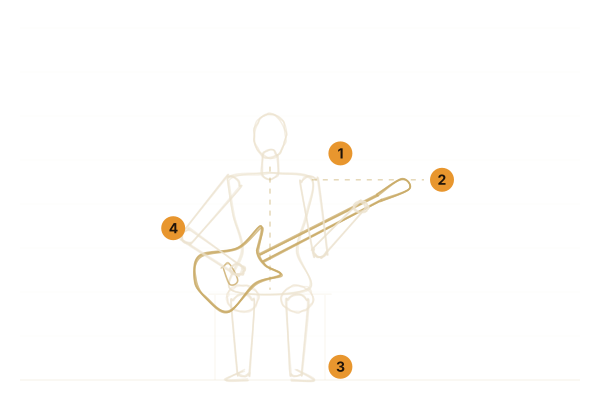
- Shoulders low, back straight.
- The headstock at shoulder height.
- Feet flat.
- The plucking forearm resting on the body.
Standing
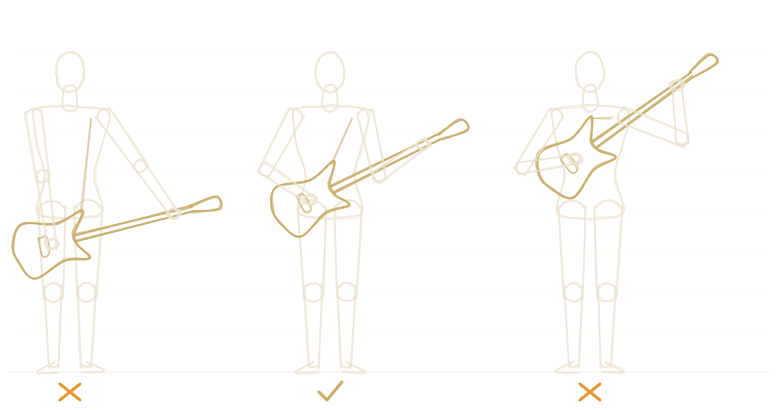
- Set your strap so the bass hangs at about the same height as when you sit. Too low, and your fretting-hand wrist bends sharply. Too high, and your right shoulder rises.
- A wide strap spreads the weight: a bass weighs 3.5 to 5 kg.
- Strap locks keep the bass from falling.
- The balance test: let go of the neck. The bass should stay roughly level. If the headstock dives, the strap or the instrument needs another look.
The fretting hand, the one on the frets
- Your thumb behind the neck, flat, roughly opposite your middle finger. It doesn’t stick up over the top of the neck.
- Your curved fingers press with their tips, just behind the fret, not in the middle of the space.
- One finger per fret: index, middle, ring and little finger cover four frets. Low on the neck, where the frets are wide, many bass players use index, middle and little finger over three frets.
- Your wrist as straight as possible.
Find the right pressure
Fret a note, then ease off little by little until it buzzes. Come back up just a touch: that’s the right pressure. No more.
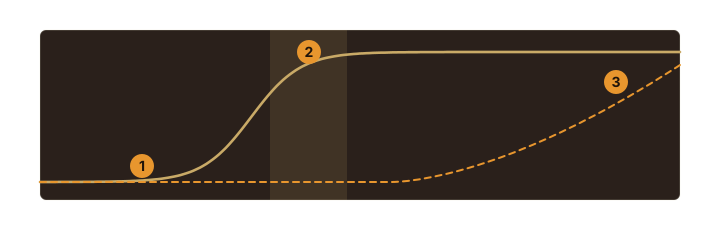
- Too little force: the note buzzes.
- The right pressure: just above the point where the note rings clear.
- Beyond that, the note gets no better, but fatigue builds, and a string pressed too hard goes sharp.
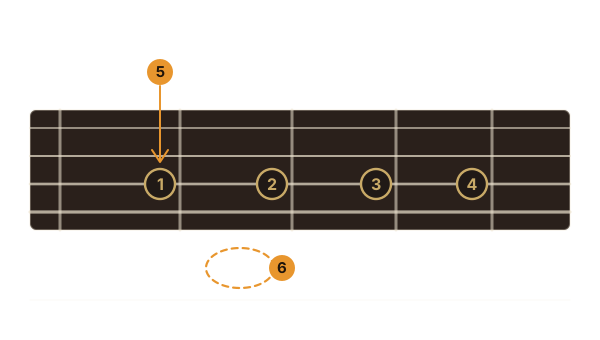
- The finger just behind the fret.
- The thumb behind the neck, opposite the middle finger.
The plucking hand, the one that plays the strings
- Your thumb rests on the pickup, or on the E string when you play the other strings.
- Index and middle fingers alternate. They pull the string toward you, without yanking it, and come to rest on the next string: that’s the rest stroke.
- A relaxed wrist, your forearm resting on the body.
Where your hand plucks also changes the sound: rounder near the neck, tighter near the bridge.
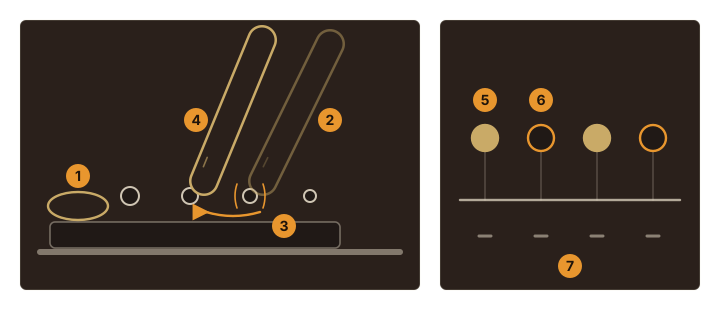
- The thumb, resting on the pickup.
- The finger, against the D string, before plucking.
- It pulls the string toward you, and the string vibrates.
- It stops by coming to rest on the next string, here the A string: that’s the rest stroke.
- Index finger.
- Middle finger.
- One note each, taking turns, on every beat.
Left-handed players
Everything flips: a left-handed bass, or a right-handed bass turned over and restrung. The fretting hand and the plucking hand switch sides, and the rules stay the same. In UnitBasse, Left-handed mode also flips the fretboard on screen (Settings › General).
What tires you out, and how to spot it
- Shoulders creeping up, a clenched jaw, holding your breath through a tricky passage.
- The mirror test, or a video of yourself playing, once a month. You can’t see yourself while you play.
- Breaks: five minutes every twenty to thirty minutes.
If you practice in front of a screen, you should be able to read it without leaning in. In UnitBasse, you can set the Fretboard size (Compact, Standard, Large, Extra large).
These tips are common sense, not medical advice. Pain that lasts should be seen by a health professional.
Frequently asked questions
Should I play sitting or standing?
Both. What matters is that the bass sits at the same height against your body either way: set your strap so that standing puts you in the same position as sitting. If you stand on stage, practice standing at home too.
How high should I set my strap?
High enough that your fretting-hand wrist stays roughly straight, low enough that your right shoulder doesn’t rise. A simple guide: standing, the bass hangs at about the same height as when you’re sitting.
My fingertips hurt. Is that normal at first?
Sore fingertips are common in the first few weeks, while the skin toughens up. Play often but in short sessions, with the right pressure. Sharp or lasting pain in your fingers, wrist or arm should be seen by a health professional.
Why does my fretting-hand wrist get tired?
Most often because it’s bent too far: the bass is too low, or the neck isn’t angled up enough. Raise your strap, bring the headstock up toward your shoulder, and check that you’re not squeezing the neck: the weight of your arm does the pressing.
Can I play with my thumb over the top of the neck?
When you’re starting out, keep your thumb behind the neck, flat, opposite your middle finger: that keeps your fingers free and your wrist straight. The thumb over the neck does exist, for specific techniques, and comes later.