 UnitBasse
Harmony · Circle of fifths
The circle of fifths:
understand it and use it on bass
The circle of fifths lays out the twelve keys, a fifth apart. Going clockwise, each key adds one sharp; going counterclockwise, one flat. At a glance, it gives you a key’s signature, its relative minor, its chords, and the order in which music most often moves from chord to chord.
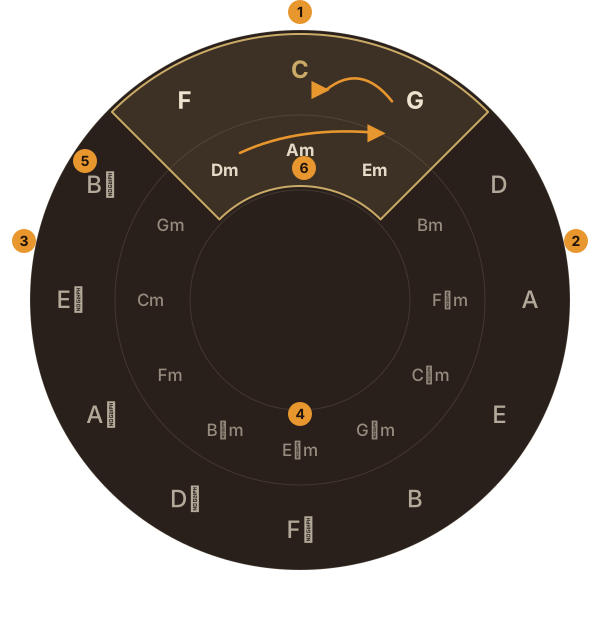
- C, at the top: no sharps or flats.
- To the right: each step a fifth higher, and one more sharp.
- To the left: each step a fifth lower, and one more flat.
- The inner ring: the relative minors.
- The C major window: six chords that belong together.
- The ii-V-I: Dm, G, C.
How it’s built
- C at the top, with no sharps or flats.
- Going up a fifth at each step: C, G, D, A, E, B, F♯. One more sharp each time.
- Going down a fifth, which is the same as going up a fourth: C, F, B♭, E♭, A♭, D♭, G♭. One more flat each time.
- At the bottom of the circle, F♯ and G♭ are the same key, written two ways.
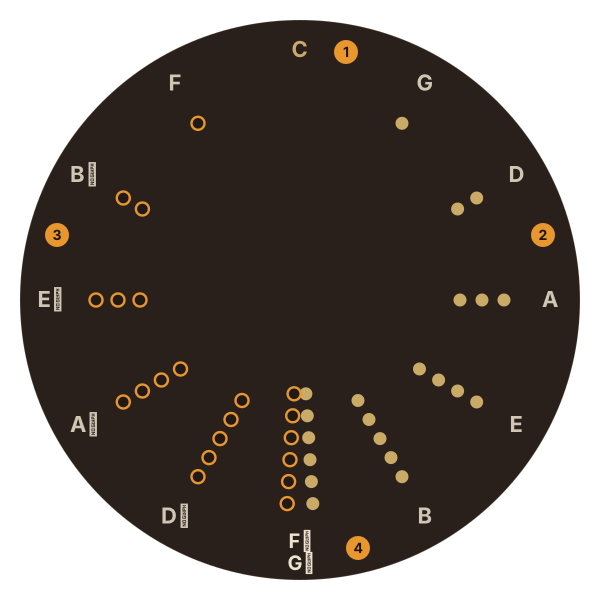
- C: no sharps or flats.
- To the right, one more sharp at each step (solid dots).
- To the left, one more flat at each step (ringed dots).
- At the bottom, F♯ (six sharps) and G♭ (six flats): the same key, written two ways.
The order of sharps and flats
Sharps always come in the same order: F, C, G, D, A, E, B. Flats come in the reverse order: B, E, A, D, G, C, F. Two tricks to find the key from a signature:
- With sharps: the last sharp is the leading tone, and the key is a half step above it. Three sharps, F♯ C♯ G♯: G♯ plus a half step, the key is A major.
- With flats: the second-to-last flat gives you the key. Three flats, B♭ E♭ A♭: E♭ major. The one exception: one flat is F major.
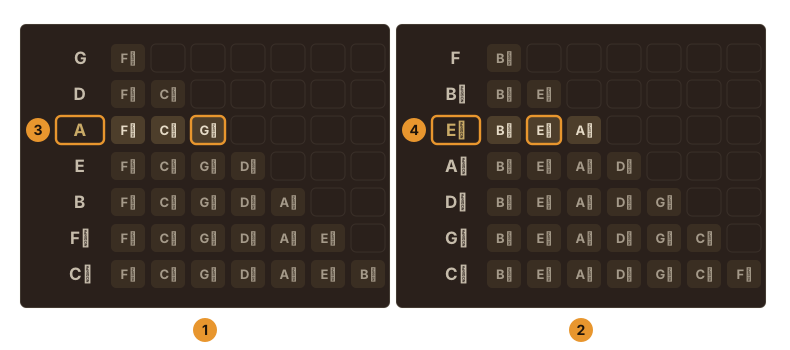
- The sharp keys: one more sharp on each row, always in the same order.
- The flat keys: one more flat on each row, in the reverse order.
- A major: the last sharp, G♯, is the leading tone; the key is a half step above.
- E♭ major: the second-to-last flat, E♭, gives the key.
Relative keys
The inner ring gives you each key’s relative minor, three half steps lower. C major and A minor share the same key signature and the same notes: the only thing that changes is the note the music comes home to.
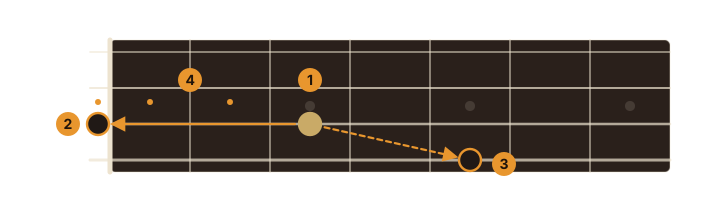
- C, the tonic of C major, on the A string, 3rd fret.
- A, its relative: three frets lower, here the open string.
- The same A, one string lower and two frets up: the shape works anywhere on the neck.
- The three half steps.
Neighboring keys
To the left and right of a key sit the keys that differ by just one sharp or flat. These are the easiest keys to modulate to: they share six notes out of seven.
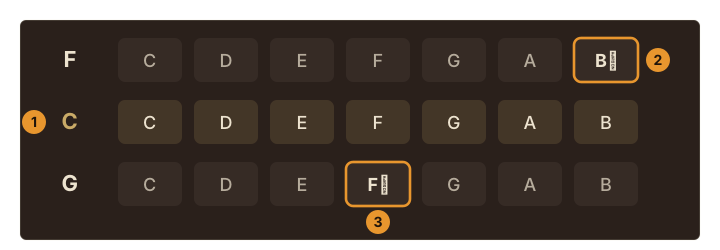
- The C major scale, with no sharps or flats.
- F major, the neighbor on the left: only one note changes, B becomes B♭.
- G major, the neighbor on the right: only one note changes, F becomes F♯.
The chord window
A key’s chords sit in a group around it. In C major: I, IV and V on the outer ring (C, F, G), and ii, iii and vi on the inner ring (Dm, Em, Am). The only one missing is the vii° (B diminished), which comes right after the V. The window’s six boxes give you six of the scale’s seven notes; the seventh is in the next box.
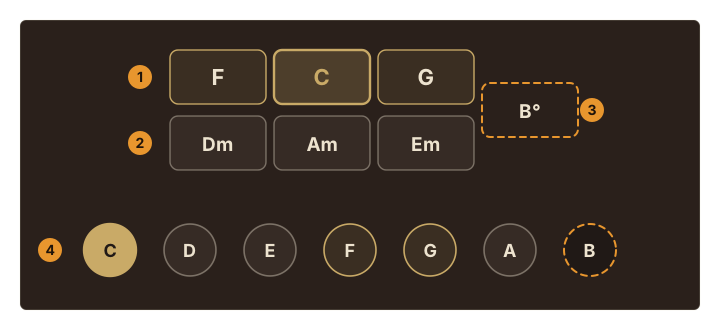
- I, IV and V: C, F, G, on the outer ring.
- ii, iii and vi: Dm, Em, Am, on the inner ring.
- The vii°, B diminished, just past the window.
- The C major scale: the roots of these seven chords, in order.
Why it matters to a bass player
- Progressions: music very often moves its chords in descending fifths. The ii-V-I (Dm, G, C), the iii-vi-ii-V-I cycle: on the circle, it’s one step to the left with each chord.
- The next root is therefore often a fourth up, or a fifth down. On the neck, that’s the same fret, on the next string up: a move your hand learns fast.
- The twelve-key exercise: a scale or an arpeggio, then the next key on the circle. After twelve, you’ve gone all the way around.
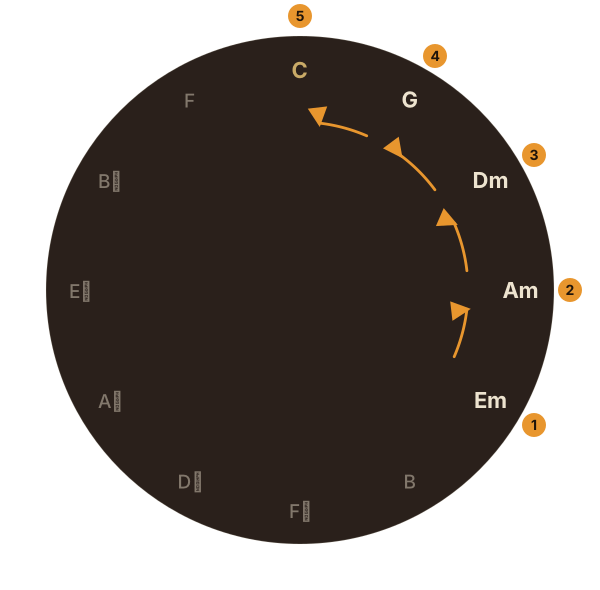
- iii: Em.
- vi: Am.
- ii: Dm.
- V: G.
- I: C, where the progression comes home.
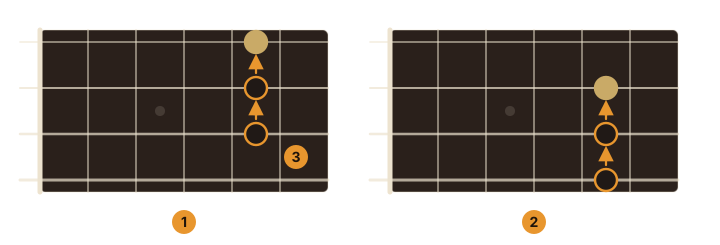
- In C: D, G, then C, at the 5th fret.
- In G: A, D, then G, the same shape one string lower.
- One step on the circle, one string on the neck.
Exercises, with answers
- Find the relative minor of E♭ major. Answer: C minor.
- Which major key has four sharps? Answer: E major (F♯, C♯, G♯, D♯: D♯ plus a half step).
- Name the chords of G major. Answer: G, Am, Bm, C, D, Em, F♯°.
- Play a ii-V-I in three neighboring keys. Answer: in C, Dm–G–C; in G, Am–D–G; in F, Gm–C–F.
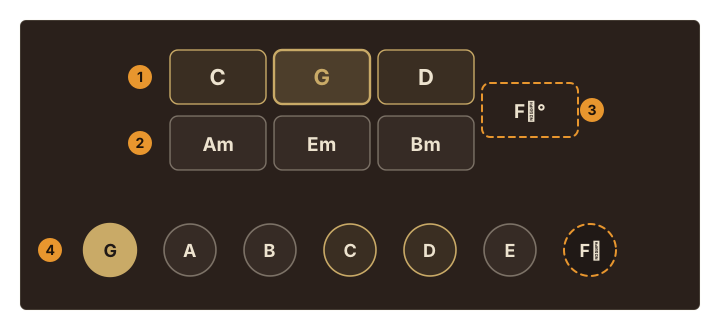
- C, G and D.
- Am, Em and Bm.
- F♯ diminished, just after.
- The G major scale, with its F♯.
With UnitBasse
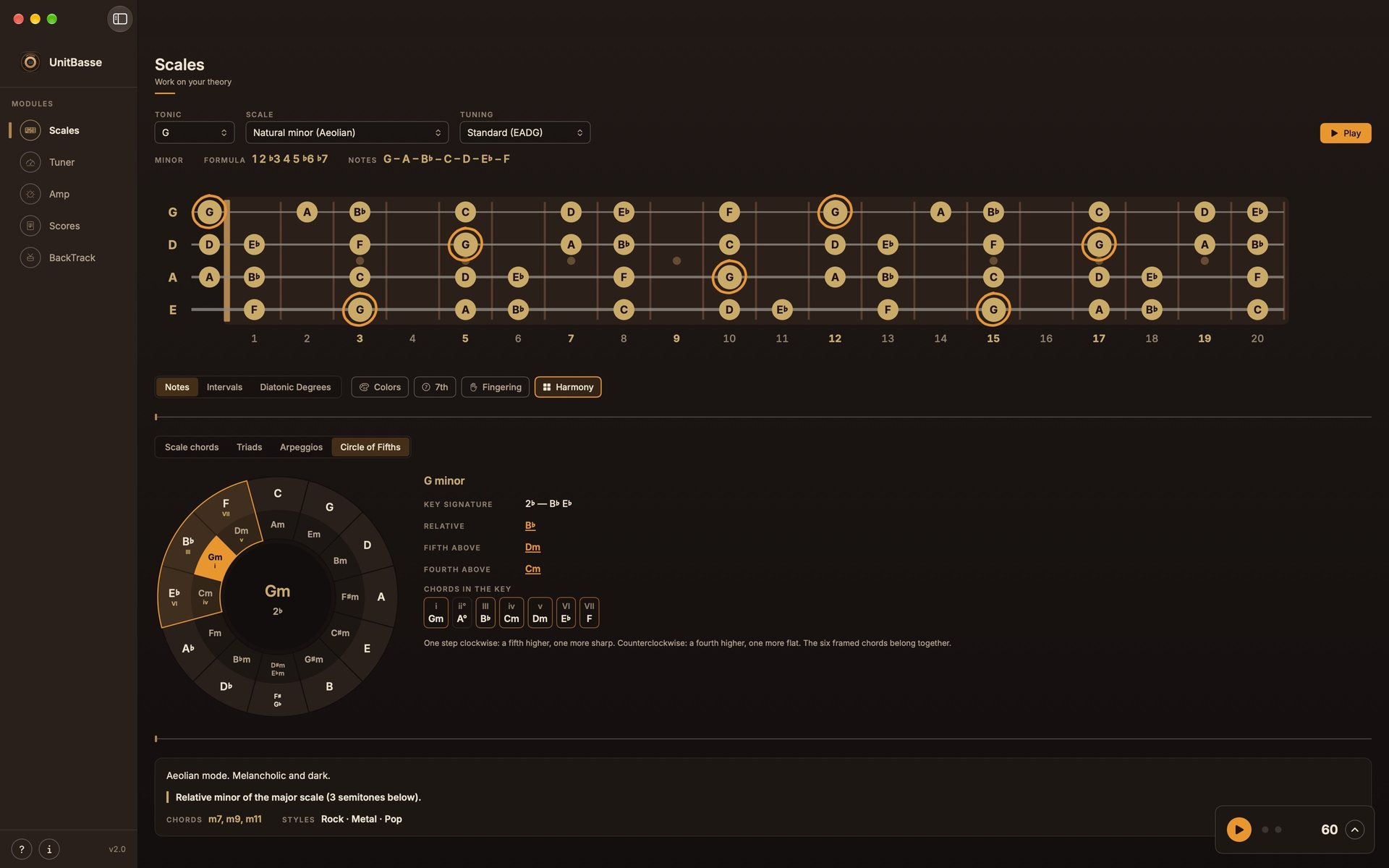
In the Scales tab, the Harmony block has a 24-box Circle of Fifths: the major keys on the outside, their relative minors on the inside. Click a box to choose the key and hear its note, played on a real bass. The panel gives the Key signature, takes you to the Relative, the Fifth above and the Fourth above, and shows the Chords in the key, with the window’s six chords framed.
Frequently asked questions
What is the circle of fifths for?
To find a key’s signature, its relative, its chords and its neighboring keys at a glance, and to understand the most common chord movement: descending fifths, like the ii-V-I.
How do I work out a key signature?
Count the steps from C: to the right, one more sharp per step; to the left, one more flat. Sharps come in the order F, C, G, D, A, E, B.
What is a relative key?
It’s the minor key that has the same key signature as a major key, three half steps lower: A minor for C major. They share the same notes.
Why “fifths” and not “fourths”?
It’s the same circle, read in both directions: up a fifth one way, up a fourth the other way. It’s named after its clockwise direction, the one in fifths.