 UnitBasse
Effects · Overdrive
Bass overdrive:
grit without losing the note
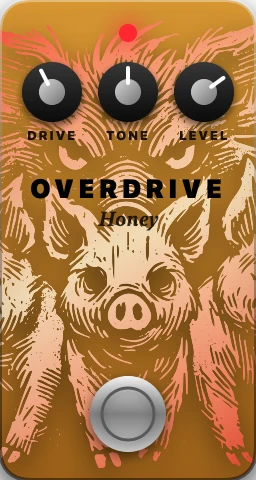
An overdrive gently saturates your tone, like a tube amp pushed hard: it adds grit and warmth without crushing the note. And it responds to your playing: play softly and the sound stays almost clean; dig in and it growls. It’s the most common kind of drive on bass.
What it does to your tone
A sound is a wave that goes up and down. When you send a circuit more signal than it can reproduce, the tops of the wave get cut off: that’s clipping. New frequencies appear above the note, the harmonics, and your ear hears them as grit.
An overdrive clips softly: it rounds off the peaks instead of slicing them. The grit stays warm, and the note keeps its shape. Along the way, it compresses a little: loud notes don’t jump out as much.
Above all, it depends on how hard you pluck. A note played softly gets through with hardly any drive; a note you dig into breaks up. You play the drive with your fingers.
| Overdrive | Distortion | Fuzz | |
|---|---|---|---|
| Clipping | soft, rounded | hard | extreme, the wave turns square |
| Response to your playing | strong | less | weak |
| Low end | kept | thinned | often lost |
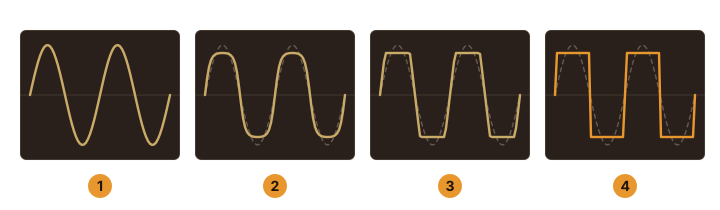
- The clean wave, no drive.
- Overdrive: the peaks get rounded.
- Distortion: the peaks are cut flat.
- Fuzz: the wave turns almost square.
What it’s for on bass
- Rock, blues, soul, garage: a light grit that thickens your line.
- Cutting through a loud band: the harmonics fill the mids, which is where your ear hears the bass when the guitars and drums get loud.
- The sound of a cranked amp, at low volume: at home, without shaking the walls.
- An always-on color: lots of bass players leave a touch of overdrive on all the time, almost unnoticeable, for warmth.
Its controls, one by one
DRIVE the amount of drive · 0 to 100 % in UnitBasse
How much drive you get. Low, just a bit of grit when you dig in. High, the note breaks up all the time and sustains more, but gets blurrier.
TONE the color · 0 to 100 %
How bright the grit is. Turn it down and it gets darker and rounder; too low and it turns muddy. Turn it up and it gets brighter; too high and it fizzes.
LEVEL the output volume · 0 to 100 %
The pedal’s volume. Set it so the pedal sounds as loud on as off: that way you’re comparing the tone, not the volume.
A starting setting
- Set the DRIVE at a quarter, the TONE halfway.
- Set the LEVEL to match the volume with the pedal off.
- Play softly, then hard: softly, the sound should stay almost clean; hard, the grit should come in. Raise the DRIVE until it does.
- Finish with the TONE, by ear, with the rest of the band if you can.
For comparison: the UnitBasse factory preset Rock sets its Overdrive to DRIVE 40 %, TONE 50 % and LEVEL 60 %, after a Compressor, on the Granite amp and an 8×10 cabinet.
The traps
- Thinning low end: the more drive, the thinner the bottom gets. Go easy on the DRIVE, and bring the lows back at the end of the chain with the EQ.
- Blurry notes: too much DRIVE and each note smears into the next. On a fast line, turn it down.
- Fizz: too much TONE gives a scratchy top end, especially on headphones.
- The volume trap: louder sounds better. Always compare on and off at the same volume, using the LEVEL.
- Hiss: drive brings up the noise between notes. A noise gate at the start of the chain cuts it.
Where to put it in the chain
In the classic order, the overdrive comes right after the amp, first of the drives, and before the modulation, delay and reverb. The compressor and the octaver stay in front: they work better on a clean note.
On a real stage, lots of bass players plug their overdrive in front of the amp: the pedal then pushes the amp’s input, and the two kinds of drive stack up. In UnitBasse, you can do both: drag the pedal in front of or behind the amp on the pedalboard, and compare.
In UnitBasse
The overdrive is called Overdrive, nicknamed Honey, in the Gain family, along with the Boost, the Distortion and the Fuzz. Its screen draws the saturation curve: you see the wave round off as you raise the DRIVE. You’ll find it in the factory preset Rock.
FAQ
Overdrive or distortion for bass?
To start with, overdrive: it keeps your low end and the dynamics of your playing. Distortion saturates more and harder, for heavy rock and metal, but it thins out the low end.
Why does my bass lose its low end with overdrive?
Because drive thins out the bottom of the sound, and the more drive, the thinner it gets. Lower the DRIVE, and bring the lows back up at the end of the chain with the EQ.
Compressor before or after the overdrive?
Most often before: even notes break up evenly. After, it smooths out the volume of the drive. Both work: listen.
Do you need a special overdrive for bass?
A pedal designed for guitar can cut some of your low end. A drive made for bass, or one blended with your clean signal, keeps the bottom of your sound.