 UnitBasse
Effects · Compressor
The bass compressor:
what it does, how to set it
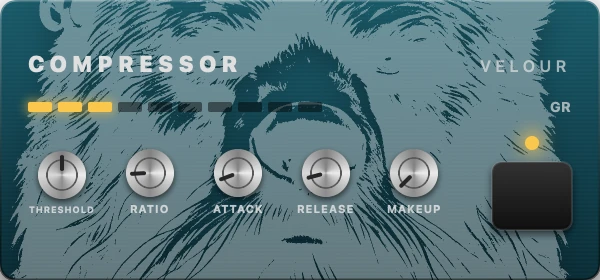
A compressor brings your loud notes and your soft notes closer together in volume. Your line gets even, your notes sustain longer, and the bass finds its place in the band. It’s the most useful effect on bass: set well, you feel it more than you hear it.
What it does to your tone
When you play, your notes don’t all come out at the same level: one finger pulls harder than the other, one string rings louder, a note you dig into jumps out. The compressor keeps an eye on the signal level. As long as it stays below a threshold, it does nothing. As soon as a note goes over, it turns that note down, and the higher the ratio, the more it turns it down: at 4:1, a note that goes 4 dB over the threshold comes out only 1 dB over.
That pulls the loud notes closer to the soft ones. Then you bring the whole thing back up with the makeup gain, to get back to your starting volume: the soft notes now come out louder than before, and the tail of each note seems to sustain longer.
Two time settings decide how it reacts: the attack, how long it waits before acting, and the release, how long it takes to give the volume back once the note drops below the threshold.
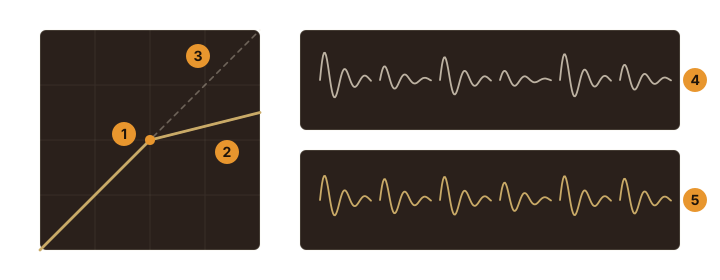
- The threshold (THRESHOLD): below it, nothing changes.
- Above it, the slope of the ratio (RATIO): at 4:1, the output rises four times more slowly than the input.
- Dotted line: the sound without compression.
- Notes played unevenly…
- … come out even, once compressed and brought back up with the MAKEUP.
What it’s for on bass
- An even line, whatever the finger or the string. That’s what lets a bass “hold” a band together.
- Notes that sustain, handy in ballads, soul and dub.
- Slap under control: the thumb and the pop crack much louder than everything else. The compressor brings them back to the level of the line.
- A recorded sound: almost every recorded bass is compressed. It’s part of that “settled” sound you hear on records.
- Setting up the other effects: an envelope filter or an octaver reacts better to even notes.
Its controls, one by one
THRESHOLD the threshold · −40 to 0 dB in UnitBasse
The level where it starts acting. The lower you set it, the more notes go over it, and the harder the compression works. All the way up, it does almost nothing.
RATIO the ratio · 1:1 to 20:1
How hard it compresses above the threshold. At 2:1 or 3:1, the effect is gentle and natural. Around 4:1, it’s clear. Past 8:1, it squashes: you’re getting close to a limiter.
ATTACK the attack · 1 to 100 ms
How long it waits before compressing. Very short, it also squashes the start of the note, and the sound goes limp. A little longer, it lets the snap of the attack through, then holds the rest of the note: your line keeps its punch.
RELEASE the release · 50 to 500 ms
How long it takes to give the volume back when the note drops below the threshold. Too short, you hear the volume swell back after every note: it “pumps.” Too long, it hasn’t finished letting go when the next note arrives, and that note comes out too quiet. On a fast line, shorten it.
MAKEUP the makeup gain · 0 to 24 dB
It brings back the volume the compression took away. Set it so the pedal sounds as loud on as it does off.
A starting setting
- Set the RATIO around 4:1, the ATTACK halfway, the RELEASE halfway.
- Lower the THRESHOLD while you play, until the compression acts a little on every note.
- Set the MAKEUP to get back the same volume as with the pedal off.
- Switch the pedal on and off while you play: your notes should come out more even, without losing their attack. If the attack gets squashed, lengthen the ATTACK; if it pumps, lengthen the RELEASE.
These values depend on your bass, your playing and the song: they’re starting points, to finish by ear. For comparison, here’s how the UnitBasse factory presets set it, from gentlest to tightest:
| Preset | THRESHOLD | RATIO | ATTACK | RELEASE | MAKEUP |
|---|---|---|---|---|---|
| Practice Clean | −22 dB | 3:1 | 15 ms | 100 ms | 2 dB |
| Rock | −15 dB | 4:1 | 8 ms | 80 ms | 4 dB |
| Funk | −12 dB | 6:1 | 5 ms | 60 ms | 5 dB |
| Metal | −10 dB | 6:1 | 5 ms | 50 ms | 6 dB |
The traps
- Pumping: release too short or compression too strong. Lengthen the RELEASE, lower the RATIO.
- A squashed attack: too fast an ATTACK flattens the start of your notes. The line loses its punch and its groove.
- The ear trap: louder always sounds better. Always compare the pedal on and off at the same volume, using the MAKEUP.
- Noise creeping up: when it brings up the soft notes, the compressor also brings up hiss and finger noise. A noise gate in front cuts them.
- Too much compression: a bass with no dynamics at all tires the ear. Better a compressor that works a little all the time than one that squashes.
Where to put it in the chain
Near the start: right after the noise gate, and before the octaver, the filters and the drives. It hands them even notes, which makes them react better. That’s its place in the classic order.
You can also put it after a drive, to smooth out its volume. Listen to both.
In UnitBasse
The compressor is called Compressor, nicknamed Velour, in the Dynamics family. Its screen draws the compression, from input to output: you see live where it starts acting and how hard. You’ll find it in the factory presets Practice Clean, Warm, Rock, Funk, Dub, Metal and Lo-Fi, almost always at the head of the chain.
FAQ
Do you need a compressor for bass?
You don’t have to have one, but it’s the most useful effect on bass. It evens out your line, which helps it hold its place in a band, and almost every bass recording uses one. Start with a gentle setting, one you feel more than you hear.
Where should the compressor go?
Early in the chain, right after the noise gate if you have one, and before the filters, the octaver and the drives: it hands them even notes. That’s its place in the classic order. You can also put it after a drive, to smooth out its volume: compare by ear.
Why does my compressor pump?
You hear the volume swell back after every loud note, like breathing. The release is too short, or the compression too strong. Lengthen the RELEASE, lower the RATIO or raise the THRESHOLD, until you can’t hear the effect anymore.
What’s the difference between a compressor and a limiter?
A limiter is a compressor set very hard (a ratio of 10:1 or more) with a high threshold: it only catches the peaks, so no note goes over a set level. A compressor works more gently, across your whole dynamic range.