 UnitBasse
Effects · Fuzz
Fuzz for bass:
saturation at its most extreme
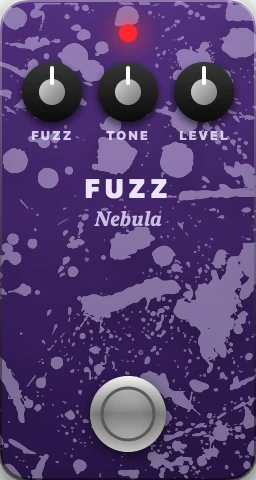
Fuzz is the most extreme kind of saturation: a grainy, buzzing sound, with a note that sustains for ages. It creates so many harmonics that the low end can vanish underneath them. On bass, you dial it in carefully, or blend it with your clean signal.
What it does to your sound
A fuzz pushes clipping as far as it will go: the wave has no peaks left and becomes almost square. The sound fills up with harmonics until it turns grainy, like a buzz.
The note sustains enormously: even as it fades, it stays distorted, and sometimes it cuts out suddenly, sputtering. How hard you play hardly changes anything any more: everything comes out at the same level.
On a bass, that flood of harmonics covers the fundamental: the low end seems to vanish, when really it’s drowned. That’s why bassists who love fuzz often blend it with their clean signal.
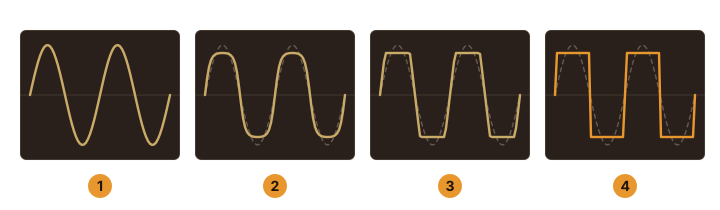
- The clean wave, no saturation.
- Overdrive: the peaks get rounded.
- Distortion: the peaks are clipped flat.
- Fuzz: the wave becomes almost square.
What it’s for on bass
- Psychedelic rock, stoner, garage: a bass that buzzes and breaks up like an amp on the edge of blowing.
- Slow, heavy lines, where every note has time to buzz.
- A lead bass sound, in place of a guitar, for a theme or a bridge.
The controls, one by one
FUZZ the amount of fuzz · 0 to 100 % in UnitBasse
How much fuzz. Even turned down, it already breaks up hard; all the way up, the sound is nothing but a compact buzz.
TONE the color · 0 to 100 %
From muffled to screaming. Turned down, a round, smothered fuzz; turned up, it bites and gets harsh.
LEVEL the output volume · 0 to 100 %
The pedal’s volume. A fuzz pushes the volume up fast: compare on and off at the same level.
A starting point
- Set FUZZ to a third, TONE a little below the middle, and adjust LEVEL to match the volume with the pedal off.
- Play a slow line on the E string: if the low end has vanished, lower the FUZZ or darken the TONE.
- If the low end is still missing, bring it back with the EQ at the end of the chain.
None of the UnitBasse factory presets uses it: a good starting point is the Rock preset, swapping the Overdrive for the Fuzz.
The pitfalls
- Drowned lows: that’s the nature of fuzz. Go easy on it, and bring the lows back with the EQ.
- Notes that run together: with a fuzz, a fast line turns to mush. It prefers slow lines.
- Hiss: a fuzz brings up a lot of noise. A noise gate at the start of the chain helps.
- Chords: two notes together sound out of tune and dirty. One note at a time.
Where to put it in the chain
With the drives, after the amp, after the overdrive and the distortion, and before the modulations and the delays. The compressor and the octaver stay in front: an octaver in front of a fuzz gives a huge synth sound, the other way round it makes the octaver stumble.
In UnitBasse
The fuzz is called Fuzz, nicknamed Nebula, in the Gain family. Its screen draws the Saturation curve: you watch the wave turn square. None of the factory presets uses it.
Frequently asked questions
Why does fuzz make my low end disappear?
It creates so many harmonics that the fundamental, the part that makes the low end, ends up buried underneath. Go easy on the FUZZ, darken the TONE, and bring the lows back with the EQ at the end of the chain.
Fuzz or distortion?
A distortion stays a dense but defined saturation; a fuzz goes all the way to a buzz, with a note that sputters as it fades. For a cleaner sound, distortion; for a wilder one, fuzz.
Can you play fast with a fuzz?
It’s hard: the notes run together. Fuzz is made for slow, heavy lines. To play fast, lower the FUZZ, or go for a distortion instead.