 UnitBasse
Effects · Distortion
Distortion for bass:
heavy grit without losing the lows
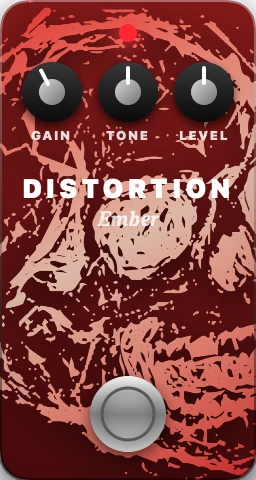
A distortion clips hard and clean: the sound gets dense, sustained, loaded with harmonics. It reacts less to your playing than an overdrive: the grit is there even when you play softly. It’s the sound of hard rock and metal, as long as you keep your low end.
What it does to your sound
Like any drive, a distortion cuts off the peaks of the wave when the signal goes beyond what the circuit can reproduce: that’s clipping. But where an overdrive rounds those peaks off, a distortion slices them flat. The wave gets closer to a square, and lots of harmonics appear above the note.
The sound gets dense and sustained: the note rings longer, because even its quieter tail stays distorted. Most of the difference between a soft note and a loud one disappears.
On bass, that density comes at a price: the more you distort, the thinner the low end gets, and the more two notes played together blur into each other.
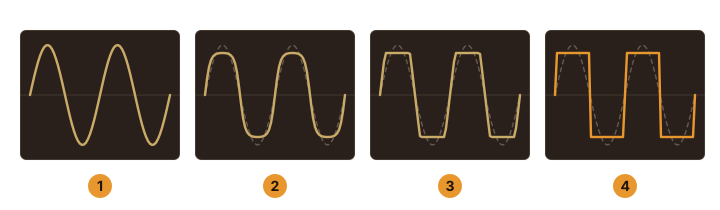
- The clean wave, no saturation.
- Overdrive: the peaks get rounded.
- Distortion: the peaks are clipped flat.
- Fuzz: the wave becomes almost square.
What it’s for on bass
- Hard rock, punk, metal: a bass that growls and holds its own against distorted guitars.
- Riffs in unison with the guitar, for a wall of sound.
- A part that has to explode, a chorus or a bridge, by kicking it on right there.
The controls, one by one
GAIN the amount of drive · 0 to 100 % in UnitBasse
How much distortion. Low, the grit is already obvious; high, a very compressed, sustained sound where the notes blend together more.
TONE the color · 0 to 100 %
The brightness. Turned down, darker and fatter; turned up, more bite. Too high and the top end gets harsh.
LEVEL the output volume · 0 to 100 %
The pedal’s volume. Set it so the pedal is as loud on as it is off.
A starting point
- Set GAIN low and TONE in the middle, and adjust LEVEL to match the volume with the pedal off.
- Raise the GAIN until you get the grit you want, but no further: a bit less drive often sounds bigger in a band.
- Play on the E string: if the low end has melted away, lower the GAIN, or bring the lows back with the EQ at the end of the chain.
For comparison: the UnitBasse Metal factory preset sets its Distortion to GAIN 60 %, TONE 55 % and LEVEL 70 %, after a Noise Gate and a Compressor, on the Obsidian amp with an 8×10 cab, and the amp’s BLEND at 85 %.
The pitfalls
- Disappearing lows: that’s the number one problem with distortion on bass. Go easy on the GAIN, and bring the lows back with the EQ.
- The fog: two notes played together distort into each other. With lots of gain, play one note at a time.
- Hiss and noise: distortion brings up everything that happens between the notes. A noise gate at the start of the chain cuts it.
- The volume trap: louder seems better. Compare on and off at the same volume, using LEVEL.
Where to put it in the chain
With the drives, after the amp, after the overdrive, and before the modulations, the delay and the reverb. The noise gate and the compressor stay in front. As with the overdrive, you can also slide it in front of the amp on the pedalboard: it then pushes the amp’s input, and the two drives stack.
In UnitBasse
The distortion is called Distortion, nicknamed Ember, in the Gain family. Its screen draws the Saturation curve: you watch the wave get closer to a square as you turn up the GAIN. You’ll find it in the Metal factory preset.
Frequently asked questions
Distortion or overdrive?
An overdrive breaks up gently and responds to your playing; a distortion clips hard, all the time, and sounds denser. For a light grit, overdrive; for hard rock and metal, distortion.
Why does my bass disappear with distortion?
Because the saturation thins out the low end, which gives the bass its weight. Lower the GAIN, keep some clean signal if you can, and bring the lows back with the EQ at the end of the chain.
Do I need a noise gate with a distortion?
It often helps: distortion brings up the hiss and string noise between the notes. A noise gate at the start of the chain cuts them; set it just above the noise.