 UnitBasse
Effects · EQ
Bass EQ:
setting your lows, mids and highs
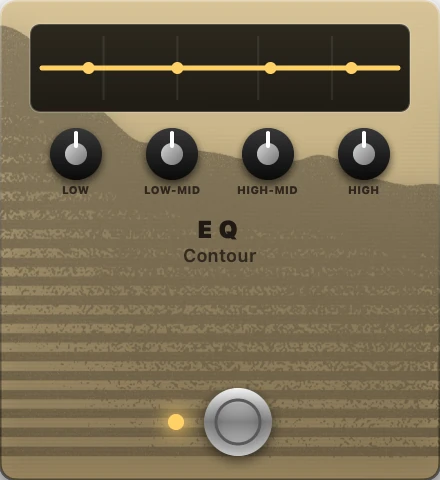
An EQ turns certain areas of your sound up or down: the lows, the mids, the highs. It fixes a bass that’s too dull or too bright, and helps the bass find its place in the band. Cutting often works better than boosting.
What it does to your tone
A bass note isn’t a single frequency: the fundamental comes with a whole series of higher harmonics. The EQ slices that spectrum into areas and lets you turn each one up or down, in decibels (dB): +6 dB is clearly louder, −6 dB clearly quieter.
Each area does its own job for your ear:
- the lows, around 40 to 100 Hz: the weight, what you feel in your gut;
- the low mids, around 200 to 500 Hz: roundness and presence. Too much, and it’s mud;
- the high mids, around 1 to 3 kHz: the attack, the grit, the clarity of the notes. That’s where you hear the bass on a small speaker;
- the highs, above that: string snap, finger noise, hiss.
There are two shapes of control. A bell band works around one frequency, like a bump or a dip. A shelf works on everything below or above a frequency.
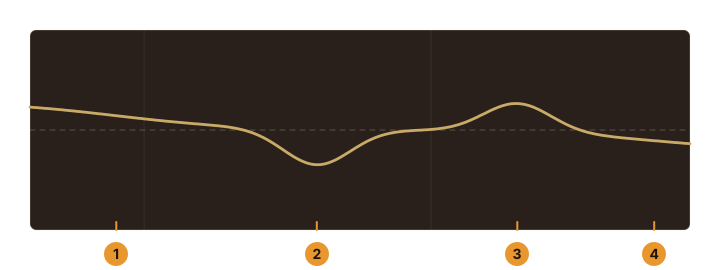
- LOW, shelf at 80 Hz: a bit more weight.
- LOW-MID, bell at 400 Hz: a dip against the mud.
- HIGH-MID, bell at 2 kHz: more clarity in the band.
- HIGH, shelf at 6 kHz: a bit less hiss.
What it’s for on bass
- Fixing a bass: too dull, too bright, a pickup that’s short on mids.
- Finding your place in the band: the kick drum lives in the lows too, the guitar in the mids. Cutting a little where another instrument plays leaves room for everyone.
- Bringing back the lows after a drive or a modulation has thinned them out.
- Sounding good on any system: a little high mid lets the bass come through even on a small speaker that can’t reproduce the lows.
Its controls, one by one
LOW the lows · shelf at 80 Hz · −12 to +12 dB in UnitBasse
Everything below about 80 Hz: the weight. Boost it carefully: low end fills a room fast and masks the kick drum.
LOW-MID the low mids · bell at 400 Hz · −12 to +12 dB
Roundness and presence. A little more gives body; too much makes the sound muddy and boxy.
HIGH-MID the high mids · bell at 2 kHz · −12 to +12 dB
The attack and clarity of the notes. A little more makes your line stand out in the band; too much sounds nasal and harsh.
HIGH the highs · shelf at 6 kHz · −12 to +12 dB
String snap, finger noise, hiss. Useful for slap; turn it down if the sound hisses or sizzles.
A starting setting
- Set all four bands to 0 dB: the EQ does nothing.
- Listen for what’s missing or what’s in the way. Start by cutting the band that bothers you, by 2 to 4 dB.
- If an area is really missing, boost it in small steps, comparing on and off.
- Always check with the rest of the band, or with the music you play: a sound on its own and a sound in a mix don’t get set the same way.
The traps
- Boosting everything: boosting all four bands is the same as turning up the volume, and it makes things clip. Cutting works better.
- Too much low end: flattering on its own, it turns to mud in the band and masks the kick drum.
- Scooping all the mids: a “V” sound, lows and highs boosted, impresses on its own but disappears in a band. The bass is heard in the mids.
- Setting it on headphones only: headphones and speakers don’t reproduce low end the same way. Compare on several systems if you can.
Where to put it in the chain
At the end of the chain, right before the cabinet: it touches up the final sound, after the drives and the modulation, and can bring back what they took away. That’s its place in the classic order. Placed at the start, it changes how the effects after it react instead: more mids before a drive, for example, make it bite harder.
In UnitBasse
The EQ is called EQ, nicknamed Contour, alone in the EQ family. Its four bands are fixed: a shelf at 80 Hz, two bells at 400 Hz and 2 kHz, a shelf at 6 kHz, each from −12 to +12 dB. Its screen draws the EQ curve, from 40 Hz to 8 kHz: you see the shape you’re giving your sound. The amp also has its own BASS, MID and TREBLE knobs: the EQ comes on top of them, at the end of the chain.
FAQ
How do I make my bass heard in the band?
Most often, by adding a bit of high mids rather than turning up the volume or the lows. That’s the area where the ear picks up your line when the other instruments are playing.
Why is my tone muddy?
Usually too many low mids or too much low end. Cut the LOW-MID a little, around 400 Hz, and the LOW if the low end is spilling over.
Amp EQ or an EQ pedal?
They work together. The amp gives you your starting color; the EQ at the end of the chain touches up the final sound, after the effects.