 UnitBasse
Effects · Chorus
Chorus for bass:
a thicker tone without losing the lows
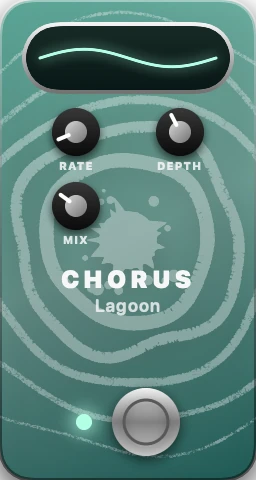
A chorus blends your sound with a slightly detuned copy that keeps wavering. The bass gets thicker and shimmers, as if two instruments were playing together. The secret on bass: keep the low end solid, with a moderate mix.
What it does to your sound
A chorus makes a copy of your sound and delays it by a tiny amount, a few thousandths of a second. That delay isn’t fixed: an oscillator keeps changing it, slowly. As it changes, it nudges the copy’s pitch up and down ever so slightly.
Blended together, the original and the copy are never quite in tune: that’s what happens when two musicians play the same note, or in a choir, hence the name. Your ear hears a wider, richer sound that shimmers.
On a bass, that slight detuning gets in the way in the low end: a very low note that wavers loses its footing and seems to float. That’s why you keep a good share of dry signal.
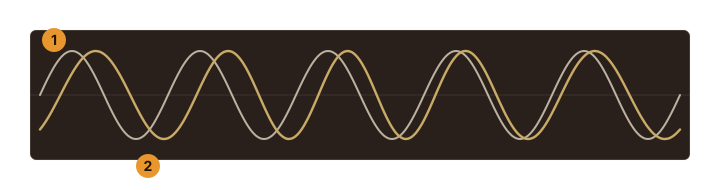
- The original wave.
- Its copy, slightly delayed; the delay changes slowly, at the speed set by RATE, by an amount set by DEPTH.
What it’s for on bass
- Pop and new wave: a bass that shines and sings, on lines in the mids.
- Ballads and arpeggios: a softer, wider sound under the vocals.
- Jazz-rock and fusion, especially on a fretless, where it goes with the singing quality of the note.
- Chords and harmonics: high up the neck, it opens up the sound.
The controls, one by one
RATE the speed · 0.1 to 5 Hz in UnitBasse
How fast it wavers, in cycles per second. Slow, the sound breathes gently; fast, it trembles and gets more upfront, almost like a vibrato.
DEPTH the depth · 0 to 100 %
How wide the wavering is: how far the copy drifts out of tune. Low, just a thickening; high, a floating sound that really stands out.
MIX the blend · 0 to 100 %
How much of the copy is in the sound. This is the key control on bass: a moderate mix keeps the low end steady, too much of the copy makes it float.
A starting point
- Set RATE slow, around 0.5 Hz, DEPTH in the middle and MIX low.
- Play a line in the middle of the neck, then raise the MIX until you hear the thickening.
- Then play on the E string: if the low end floats, bring the MIX or the DEPTH back down.
For comparison: the UnitBasse Synthwave factory preset sets its Chorus to RATE 0.4 Hz, DEPTH 50 % and MIX 40 %, after the Synth and before a Delay.
The pitfalls
- Floating lows: too much MIX or DEPTH and the low notes lose their footing. That’s the number one trap on bass.
- A sound that goes soft: a strong chorus left on all the time takes the definition out of your attack. In a busy band, save it for certain parts.
- Seasickness: a fast RATE with lots of DEPTH gives a vibrato that quickly gets tiring.
Where to put it in the chain
After the amp and the drives, with the other modulations, and before the delay and the reverb. After a drive, it modulates a sound that’s already rich; before one, the drive flattens its wavering. That’s its place in the classic order.
In UnitBasse
The chorus is called Chorus, nicknamed Lagoon, in the Modulation family, along with the Flanger, the Phaser and the Tremolo. Its screen shows the oscillator over two seconds: you see the speed and the width of the wavering. It has no feedback control: it’s a true bass chorus, not a flanger. You’ll find it in the Synthwave factory preset.
Frequently asked questions
Why does my chorus make the low end blurry?
Because the detuned copy wavers in the low end too, where your ear barely tolerates any detuning. Lower the MIX or the DEPTH: the low end stays solid, and you hear the effect in the mids and highs.
What’s the difference between a chorus and a flanger?
Both blend the sound with a delayed copy that keeps changing. A flanger uses a much shorter delay and sends part of the sound back into the effect: it gives a metallic sweep. A chorus is gentler: it thickens and shimmers.
Chorus on a fretless?
It’s a classic combination: the chorus goes with the singing quality of the fretless note. Keep the mix moderate to hold on to the low end.