 UnitBasse
Effects · Flanger
Flanger for bass:
the metallic sweep
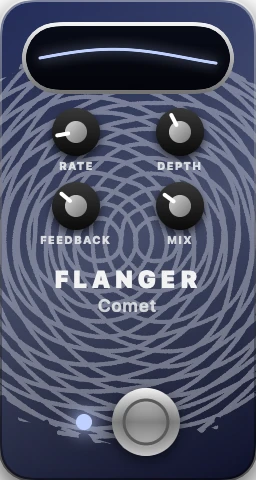
A flanger sweeps your sound with a metallic swoosh, like a jet plane flying past. It’s a very strong effect: use it sparingly, or on a specific passage. It works like a chorus, with a shorter delay and part of the sound fed back into the effect.
What it does to your sound
A flanger mixes your sound with a copy delayed by just a few thousandths of a second, much less than a chorus. With such a short delay, the mix carves a series of evenly spaced notches into the spectrum, like the teeth of a comb.
An oscillator varies that delay: the comb slides along the spectrum, from low to high. That sliding is what you hear as a sweep. Feedback sends part of the sound back into the effect: the notches get deeper and the sound more metallic, almost resonant.
The name comes from an old studio trick: engineers slowed down a tape reel by pressing on the edge of it, the “flange”.
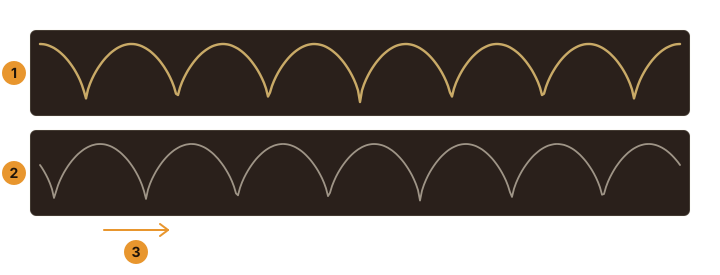
- Evenly spaced notches, like the teeth of a comb: FEEDBACK makes them deeper.
- A moment later, the comb has slid along.
- That sliding, at the speed set by RATE, is the sweep you hear.
What it’s for on bass
- A one-off effect: an intro, a break, a long note.
- Rock and new wave, on simple lines in the mids.
- Slap and harmonics, where the sweep comes through clearly on the attacks.
The controls, one by one
RATE speed · 0.05 to 2 Hz in UnitBasse
The speed of the sweep. Slow, a long jet fly-past; faster, a whirl.
DEPTH depth · 0 to 100 %
How far the sweep travels across the spectrum.
FEEDBACK feedback · 0 to 95 %
The metallic character. Low, a gentle sweep; high, a resonant sound, almost a whistling note.
MIX blend · 0 to 100 %
How much of the effect you hear. At halfway, the notches are deepest; lower, the effect stays in the background.
A starting point
- Set RATE slow, DEPTH to halfway, FEEDBACK low, and MIX to around 40 %.
- Play a long note and listen to the sweep go by.
- Raise FEEDBACK for a more metallic sound, or lower MIX for a subtler effect.
The pitfalls
- Leaving it on all the time: it’s very recognisable and quickly gets tiring. Save it for specific passages.
- Thinner lows: the notches sweep through the lows too. Lower DEPTH or MIX.
- Whistling: FEEDBACK at the top resonates loudly.
Where to put it in the chain
After the drive pedals, with the other modulation effects, before the delay and the reverb: drive after it would bring out its whistle. That’s its place in the classic order, right after the chorus.
In UnitBasse
The flanger is called Flanger, nicknamed Comet, in the Modulation family. Its display, Oscillator (2 seconds), shows you the speed and the depth of the movement. No factory preset uses it.
Frequently asked questions
Flanger or chorus?
A chorus uses a longer delay, with no feedback: it thickens the sound and makes it shimmer. A flanger, with a very short delay and feedback, gives a metallic sweep.
Why does my flanger whistle?
FEEDBACK is too high: the notches get so deep that some frequencies start to resonate. Turn it down.
Does a flanger work on bass?
Yes, used sparingly and mostly on specific passages. On a low line that runs all the time, it thins the sound.