 UnitBasse
Harmony · Modes
Bass modes:
the 7 modes explained simply
The seven modes are seven scales taken from the major scale: the same notes, but a different starting point. Each one has a note that gives it its color. On bass, you choose the mode according to the chord: Dorian over a funky minor chord, Mixolydian over a seventh chord, Aeolian for a darker minor.
Where the modes come from
Take the C major scale: C, D, E, F, G, A, B. Play those same seven notes, but start on D and stop on D: that is the Dorian mode of D. Start on E: that is E Phrygian. And so on, one note after another. You get seven modes, one for each degree of the major scale.
The notes are the same, but the starting note changes everything: the half steps are no longer in the same place relative to it, and your ear hears a different color.
The seven modes in one table
The degrees are read relative to the root of the mode. ♭ means “a half step lower than in the major scale”, ♯ “a half step higher”.
| Mode | Degrees | The note that gives its color | Chord | Where you hear it |
|---|---|---|---|---|
| Ionian | 1 2 3 4 5 6 7 | it is the major scale | maj7 | pop, songwriting |
| Dorian | 1 2 ♭3 4 5 6 ♭7 | the major sixth (6) | m7 | funk, soul, modal jazz |
| Phrygian | 1 ♭2 ♭3 4 5 ♭6 ♭7 | the minor second (♭2) | m7 | flamenco, metal |
| Lydian | 1 2 3 ♯4 5 6 7 | the augmented fourth (♯4) | maj7 | film music, jazz |
| Mixolydian | 1 2 3 4 5 6 ♭7 | the minor seventh (♭7) | 7 | rock, blues, funk |
| Aeolian | 1 2 ♭3 4 5 ♭6 ♭7 | the minor sixth (♭6) | m7 | rock, pop, ballads |
| Locrian | 1 ♭2 ♭3 4 ♭5 ♭6 ♭7 | the diminished fifth (♭5) | m7♭5 | rare alone; jazz, metal |
Aeolian is the “natural” minor scale, often simply called “the minor scale”.
The most useful way to think about them
Thinking “same notes, different start” helps you understand where the modes come from. To play, another approach works better: keep the same root, and look at what changes. D Dorian and D Aeolian, for example, differ by a single note: the B of Dorian becomes B♭ in Aeolian. That one note takes you from a warm minor to a dark minor.
Hence a simple rule: find the note that gives the mode its color, and bring it out in your line. That is the note the ear is waiting for.
An example on the neck: D Dorian
D Dorian over one octave, starting from the 5th fret of the A string. The numbers are the degrees. The 6, in orange, is the note that gives Dorian its color.
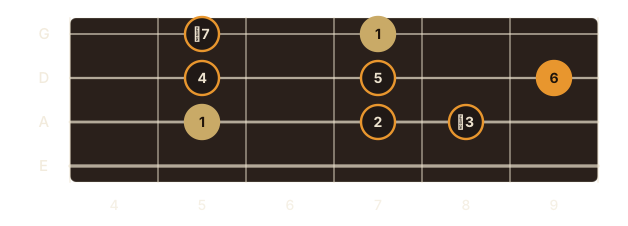
Play it slowly with a metronome, then over a held D minor chord: lean on the B and hear how it brightens the chord. Dorian is the color of many funk and modal jazz tunes, such as Miles Davis’s “So What”, in D Dorian.
Which mode over which chord
- Minor chord (m7): Dorian for a funk or jazz sound, Aeolian for a darker sound, Phrygian for a Spanish or metal color.
- Seventh chord (7): Mixolydian. It is the color of blues, rock and funk.
- Major chord (maj7): Ionian for a simple sound, Lydian for a more open, “suspended” sound.
- Half-diminished chord (m7♭5): Locrian, mostly in minor jazz progressions.
On bass, the root of the chord remains the most important note. The mode helps you choose your passing notes and color the line between two roots.
Practice them with UnitBasse
In UnitBasse, the app’s 69 scales are shown across the whole neck, in all twelve keys, as note names, intervals or degrees, with one color per degree. You can listen to them, see the chords of each scale and switch keys in one click. All seven modes are there, along with the major scale and the minor scales. To hear a mode in context, play it over a chord chart in BackTrack, the app’s backing band.
Frequently asked questions
Do you need to know the modes to play bass?
Not to start with: the major, the minor and the pentatonics will take you a long way. The modes become useful when you want to choose your passing notes according to the chord, in funk, jazz or rock.
Which mode should you learn first?
Dorian and Mixolydian, the two most used on bass: Dorian over minor chords, Mixolydian over seventh chords.
What is the difference between Aeolian and natural minor?
None: they are two names for the same scale.
Why do the modes all sound the same when I play them alone?
Because without a chord behind them, your ear hears the original major scale. Play each mode over its held root, or over a chord, to hear its real color.