 UnitBasse
Harmony · Scales
The minor pentatonic scale on bass:
understand it and play it
The minor pentatonic has five notes: the root, the minor third, the fourth, the fifth and the minor seventh. None of them clash, so it fits almost any minor chord. It is the most played scale in rock, blues, funk and soul.
Also called: minor pentatonic, pentatonic minor.
The five notes
In A, the minor pentatonic gives A, C, D, E, G. As degrees: 1, ♭3, 4, 5, ♭7. Compared with the natural minor scale, it leaves out two notes, the second and the sixth. Those are exactly the two notes that clash with some chords: without them, the scale sounds right almost everywhere.
| Degree | Name | In A | Role in a line |
|---|---|---|---|
| 1 | root | A | the anchor, on the first beat |
| ♭3 | minor third | C | gives the minor color |
| 4 | perfect fourth | D | passing note, much used in blues |
| 5 | perfect fifth | E | solid, always safe under the chord |
| ♭7 | minor seventh | G | leads to the octave, very funky |
The most useful position
Here is the A minor pentatonic position at the 5th fret. It fits under four fingers, over three or four frets, with two notes per string. It is the shape almost every bass player learns first.
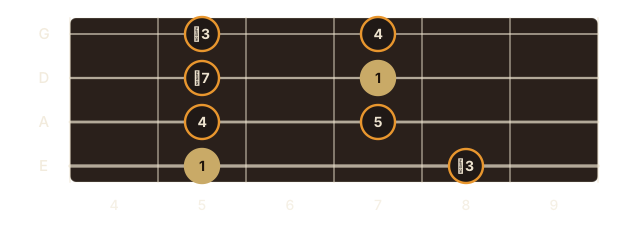
The same position as bass tab:
G|-5--7-|
D|-5--7-|
A|-5--7-|
E|-5--8-|
The shape moves as it is: at the 3rd fret it is the G minor pentatonic; at the 8th fret, C. Just put the root on the E string.
Its cousin: the blues scale
Add a single note, the diminished fifth (♭5), and the minor pentatonic becomes the blues scale. In A, that is E♭, between D and E. You play it in passing, as a color note, almost never on a strong beat.
Another useful link: the A minor pentatonic has the same notes as the C major pentatonic. Like the major and minor scales, they are relatives.
How to practice it
- Go up and down the position with a metronome at 60 BPM, one note per beat, then two. Add 5 BPM when it is clean.
- Play it over a held A minor chord: you hear which notes “rest” (1, 5) and which ones move forward (4, ♭7).
- Make a two-bar line using only the root, the fifth and the minor seventh. That is already a funk line.
- Change key: move the shape to G, then to D, without looking at the diagram.
Going further with UnitBasse
This diagram shows only one position, in one key. In UnitBasse, the app’s 69 scales are shown across the whole neck, in all twelve keys, as note names, intervals or degrees, with one color per degree. You can listen to them, see the chords of each scale and switch keys in one click. The minor pentatonic is there with its variants, the major pentatonic and the blues scale. To play it in context, start a blues or funk chart in BackTrack and play over it.
Frequently asked questions
Why start with the minor pentatonic?
Because it has only five notes, none of which clash, and a single shape is enough to play in every key. It is the basis of thousands of rock, blues and funk lines.
Minor pentatonic or blues scale?
The blues scale is the minor pentatonic plus one note, the diminished fifth. Learn the pentatonic first, then add the blue note in passing.
Which chords do you play it over?
Over minor chords with the same root (Am, Am7), and over a whole blues: the A minor pentatonic works over a blues in A, even over the seventh chords.