 UnitBasse
Harmony · Scales
The Mixolydian mode on bass:
notes, formula and position
The Mixolydian mode has 7 notes: 1 2 3 4 5 6 ♭7. In A, that gives A, B, C♯, D, E, F♯ and G. A major scale with a minor seventh: the scale of seventh chords, blues, rock and funk. In Indian music, raga Khamaj uses the same notes.
Also called: Mixolydian, Mixolydian scale, Khamaj, dominant scale.
Formula and notes
1 2 3 4 5 6 ♭7
The steps between the notes, from the root to the octave: whole step – whole step – half step – whole step – whole step – half step – whole step. In A:
| Degree | Interval | Note in A | Half steps |
|---|---|---|---|
| 1 | root | A | 0 |
| 2 | major second | B | 2 |
| 3 | major third | C♯ | 4 |
| 4 | perfect fourth | D | 5 |
| 5 | perfect fifth | E | 7 |
| 6 | major sixth | F♯ | 9 |
| ♭7 | minor seventh | G | 10 |
Where the Mixolydian mode comes from
It is the 5th mode of the major scale: you play the notes of the major scale starting from its 5th degree. The Mixolydian mode in A therefore has the same notes as D major. What changes is the home note: the root A, the note your line keeps coming back to.
One position on the neck
The Mixolydian mode in A, in the 5th-fret position: one finger per fret, from the 4th to the 8th fret, on all four strings. The numbers are the degrees; the root is in gold.
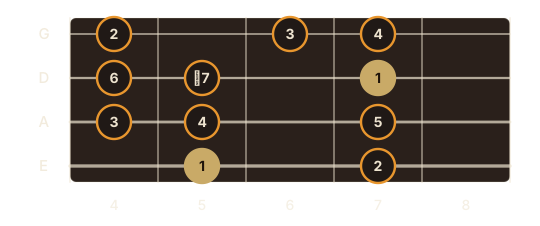
The same position as bass tab (fret by fret, from the low E string to the G string):
G|-4--6--7-|
D|-4--5--7-|
A|-4--5--7-|
E|-5--7-|
For another key, move the whole shape: the root on the E string sets the key (3rd fret for G, 8th fret for C).
The sound of the Mixolydian mode
5th mode. Major with ♭7, the dominant sound. THE mode for 7 chords and rock.
You mostly hear it in rock, blues, funk and country.
Which chords to play it over
In A, the Mixolydian mode fits A7, A9 and A13. On bass, keep the root on the strong beats and use the other notes to connect the chords.
Neighbouring scales
These scales differ from the Mixolydian mode by a single note. Comparing them lets you hear exactly what that note brings.
- The major scale: 7 instead of ♭7.
- The Dorian mode: ♭3 instead of 3.
- The Lydian dominant scale: ♯4 instead of 4.
- The Mixolydian ♭6 mode: ♭6 instead of 6.
Practice it with UnitBasse
This diagram shows a single position, in a single key. In UnitBasse, this scale is shown across the whole neck and in all twelve keys, as note names, intervals or degrees, with one color per degree. You can listen to it, see the chords that go with it, switch keys in one click, and play it over a chord chart with BackTrack, the app’s backing band. The app has 69 scales in 12 families.
Frequently asked questions
How many notes are in the Mixolydian mode?
7 notes: 1 2 3 4 5 6 ♭7. In A: A, B, C♯, D, E, F♯ and G.
What are the notes of the Mixolydian mode in A?
A, B, C♯, D, E, F♯ and G.
Which chord do you play the Mixolydian mode over?
In A, over A7, A9 and A13. In another key, over the same chords built on the root.
Which scale does the Mixolydian mode come from?
It is the 5th mode of the major scale.