 UnitBasse
Effects · Creative
The UnitBasse creative effects
Six effects unique to UnitBasse, to get away from the usual bass sound: Synth, Tape, Swarm, Warp, Plasma and Fracture. They have no exact pedal equivalent, but each one draws on a family of effects that does exist. They all have a MIX control: start it low, and add the effect to your bass sound rather than replacing it.
- Synth, the bass synth
- Tape, the worn-out tape
- Swarm, the swarm of voices
- Warp, the sound that bends
- Plasma, the electric sound
- Fracture, the broken digital sound
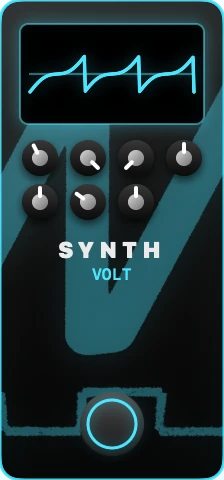
Synth Volt · The bass synth
What it does to the sound
The Synth turns your bass into a synthesizer. It listens to the note you play, recognizes its pitch, and generates two new voices that follow it: a square wave an octave lower, with the hollow, nasal sound typical of synths, and a smooth wave two octaves lower, very deep. Their volume follows how hard you play.
All of it goes through a resonant low-pass filter, like the ones on analog synths: it removes the highs above a given frequency, and the resonance emphasizes that frequency, all the way to a whistle. On top of that, the filter opens on every attack, like an envelope filter: every note goes “wow”.
In pedal terms, this is the bass synth family, which combines pitch detection, oscillators and a filter. Like them, it needs single, clean notes to track well.
Its controls
MIX
How much synth is in the sound, blended with your bass.
OCTAVE
The volume of the square wave an octave lower: the heart of the synth sound.
SUB OCT
The volume of the wave two octaves lower: a huge low end, felt more than heard.
FILTER
The filter frequency, from 100 to 5,000 Hz: low, a dark, round sound; high, an open, bright sound.
RESONANCE
The emphasis on the filter frequency: the higher it goes, the sharper and more “synth” the sound gets.
SATURATION
Grit that thickens the sound before the filter.
ENVELOPE
How far the filter opens on each attack: at zero, it stays fixed; high, every note “talks”.
Try it
Play a funk or electronic line one note at a time, in the middle of the neck. Start from the Synthwave factory preset, which uses it with MIX 50%, OCTAVE 60%, SUB OCT 30% and RESONANCE 40%, followed by a Chorus and a Delay.
Its place in the chain
Right at the start of the chain, after the compressor and the octaver, before the filters and the amp: it needs the cleanest note possible.
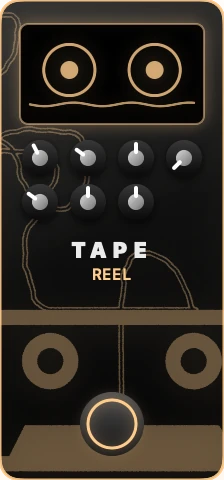
Tape Reel · The worn-out tape
What it does to the sound
Tape mimics a tired old tape recorder. It brings together everything tape does to sound:
- gentle compression, which squashes the loud notes;
- tape saturation, rounded and slightly asymmetrical, warmer than a pedal’s;
- wow and flutter: the tape never runs at a perfectly steady speed, so the pitch wavers, slowly (wow) and with a faster tremble (flutter);
- wear: aged tape loses its highs;
- hiss, that soft background noise of cassettes.
In pedal terms, this is the family of tape simulators and lo-fi pedals, which go after that warm, slightly unstable sound of old recordings.
Its controls
MIX
How much tape sound there is, blended with the dry sound.
WOW/FLUTTER
The pitch wobble. A little: a living warmth; a lot: tape that’s getting chewed up.
SATURATION
The grit of tape pushed hard.
HISS
The background hiss.
AGE
The wear: the higher it goes, the more the highs disappear.
COMPRESSION
How much the loud notes get squashed, like tape gently saturating.
SPEED
The character of the wobble: more of a slow undulation, or more of a fast tremble.
Try it
For a lo-fi sound, or to warm up a line that’s too clean. Start from the Lo-Fi factory preset, which uses it with MIX 60%, SATURATION 50%, WOW/FLUTTER 40% and AGE 30%, with a Compressor.
Its place in the chain
Toward the end of the chain, after the modulations and before the delay and reverb: like a tape you’ve recorded the sound onto.
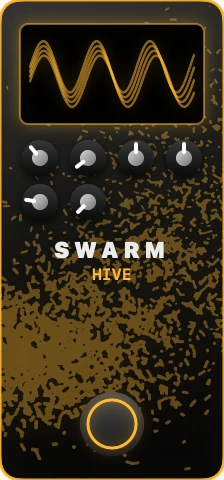
Swarm Hive · The swarm of voices
What it does to the sound
Swarm copies your note into several voices, from two to six. Each voice is slightly detuned, and each one wavers slowly, at its own speed. Together, they never quite agree: the sound widens, moves, and buzzes like a swarm.
It’s the chorus principle, pushed much further: a chorus adds one copy, Swarm adds up to six. Gentle saturation can melt them together, and a shimmer control adds a metallic sparkle on top.
In pedal terms, this is the family of multi-voice choruses and ensemble effects, which mimic several instruments playing the same thing.
Its controls
MIX
How much swarm there is, blended with the dry sound. Keep some dry signal so the low end stays steady.
DETUNE
How far apart the voices are tuned: a little, a wide sound; a lot, a sound that grinds.
SPREAD
How far apart the voices spread: toward 0, the swarm tightens; toward 1, each voice gets its own delay and wobbles more.
VOICES
The number of voices, from 2 to 6. The more there are, the thicker the sound.
SATURATION
Melts the voices together with gentle grit.
SHIMMER
Adds a metallic, sparkling brightness on top of the sound.
Try it
For pads, an intro, a slow passage played in long notes. No factory preset uses it: start with MIX low, 4 voices, a little DETUNE.
Its place in the chain
After the saturation effects and before the classic modulations, in the UnitBasse order.
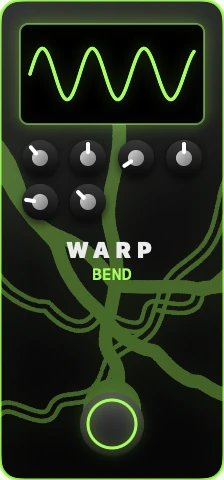
Warp Bend · The sound that bends
What it does to the sound
Warp combines two movements. First a flanger: a very slightly delayed copy of the sound, whose delay varies, with part of it sent back into the effect; the spectrum gets notched and sweeps. Then a pitch wobble, driven by the same oscillation: the sound seems to twist and bend.
Saturation can harden the whole thing. The result is an unstable, wavering sound, somewhere between a flanger and warped tape.
In pedal terms, it’s reminiscent of extreme flangers, vibratos and lo-fi warp pedals.
Its controls
MIX
How much effect there is, blended with the dry sound.
WARP
The pitch wobble: how far the sound bends.
SPEED
The speed of the oscillation, from 0.6 to 25.1 Hz (1.6 Hz by default): slow, it undulates; fast, it trembles.
FLANGER
The depth of the flanger sweep.
DRIVE
A touch of saturation on the effect.
FEEDBACK
How much of the sound is sent back into the effect: the higher it goes, the more metallic and resonant the sweep becomes.
Try it
For a texture, an effect on a few notes, a sound that “melts”. No factory preset uses it: start with MIX low and SPEED slow.
Its place in the chain
After the saturation effects, right after Swarm, before the classic modulations.
Plasma Ion · The electric sound
What it does to the sound
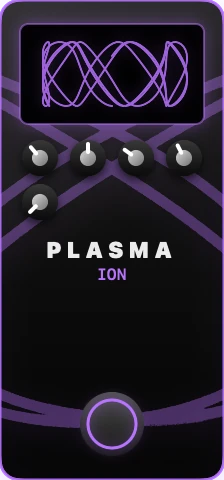
Plasma is a ring modulator: it multiplies your sound by a sine wave at a fixed frequency. That multiplication creates new frequencies that aren’t harmonically related to the note: the sound becomes metallic, electric, like a bell or a robot voice.
On top of the modulator, Plasma adds a dose of chaos, which makes the wave drift and sends part of the sound back into the effect, a pulse that makes the volume throb, and tube saturation.
In pedal terms, this is the ring modulator family, the noise effects par excellence. On bass, they completely change the note: use with care.
Its controls
MIX
How much effect there is. The higher it goes, the less you recognize the original note.
FREQUENCY
The frequency of the wave, from 10 to 500 Hz: low, the sound vibrates and crackles; high, it turns metallic.
CHAOS
The drift and the effect feeding back into itself: the sound becomes unstable and unpredictable.
SATURATION
Tube grit that thickens the whole thing.
PULSE
A throbbing of the volume, faster and faster.
Try it
For an effect on a long note, an intro, the end of a song. No factory preset uses it: start with MIX low and FREQUENCY low.
Its place in the chain
With the saturation effects, after the amp, behind the fuzz.
Fracture Shard · The broken digital sound
What it does to the sound
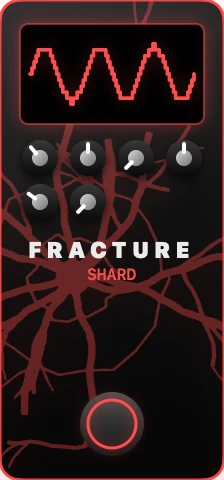
A digital sound is described by a series of values, taken thousands of times per second. Fracture deliberately damages that description, in two ways:
- it reduces the bit depth, that is, how finely levels are described: the sound becomes grainy, like old video game consoles;
- it reduces the sample rate: by keeping fewer values, it brings out stray, metallic frequencies.
What makes it special: the damage can follow your playing, stronger when you dig in, or the other way round, when you play softly. Saturation and a gate complete the package.
In pedal terms, this is the family of bitcrushers and decimators, widely used in electronic music and lo-fi.
Its controls
MIX
How much broken sound there is, blended with the dry sound.
CRUSH
The bit depth reduction: the higher it goes, the grainier the sound.
SAMPLE
The sample rate reduction: a more and more metallic, aliased sound.
DYNAMICS
How the damage follows your playing: above the middle, it increases when you dig in; below, when you play softly.
DISTORTION
Saturation on the broken sound.
GATE
Cuts the sound when it gets quiet, for tight note endings.
Try it
For electronic music, hip-hop, an “8-bit” passage. No factory preset uses it: start with MIX low, CRUSH in the middle, SAMPLE at zero.
Its place in the chain
With the saturation effects, after the amp, last in that family.
Frequently asked questions
Do these effects exist as pedals?
They’re unique to UnitBasse, with their own controls, but each one draws on a family that does exist: the bass synth, the tape simulator, the multi-voice chorus, the flanger, the ring modulator and the bitcrusher.
How do I try them without losing my bass sound?
Always start with their MIX low: you add the effect to the dry sound instead of replacing it. Then turn it up, by ear.
Can I combine them?
Yes: the Synthwave factory preset chains the Synth, a Chorus and a Delay. For other combinations, experiment, and change their order by dragging them on the pedalboard.