 UnitBasse
Effects · Octaver
The bass octaver:
an octave below, or above
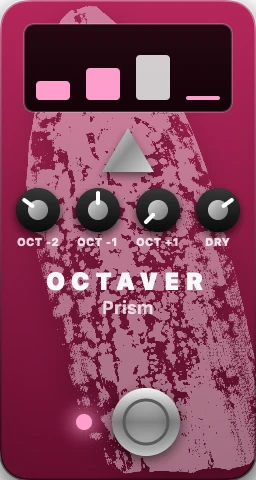
An octaver adds the same note to yours, one octave down, two octaves down or one octave up. The sound gets huge and round, close to a synth bass. To track well, it needs notes played one at a time, and played cleanly.
What it does to your tone
An octave is the same note, twice as low or twice as high: its frequency is halved or doubled. Your open A string vibrates at 55 Hz; an octave below is 27.5 Hz, an octave above, 110 Hz.
The octaver listens to the note you play, works out its pitch, and creates those new notes, which it blends with your dry sound. Since it has to recognize the note first, it needs it to be clear: a single note, cleanly plucked, with no other strings ringing.
Way down low, the octave below almost falls out of what your ear can hear. The low E vibrates at about 41 Hz: an octave below is 20.6 Hz, at the edge of hearing. You feel it more than you hear it, and a small speaker can’t reproduce it. So the octaver does its best work in the middle of the neck.
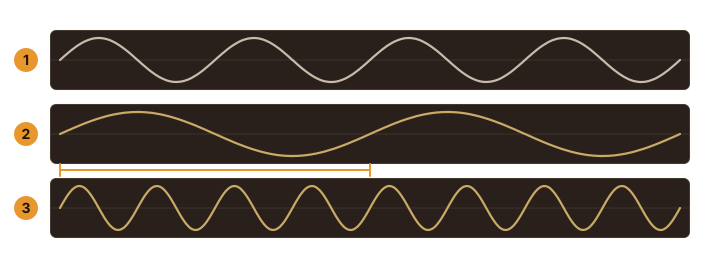
- The note you play.
- The octave below (OCT -1): a wave twice as slow, lower.
- The octave above (OCT +1): a wave twice as fast, higher.
What it’s for on bass
- Synth bass: with the octave below, a funk or electro line takes on the weight of a synth.
- Dub and reggae: deep, round low end that fills the room.
- Playing high on the neck without losing the low end: a line played up high keeps its foundation thanks to the octave below.
- Beefing up a section, a chorus, a riff in unison with the guitar.
- The octave above: a brighter color, close to an organ, for a melody or a solo.
Its controls, one by one
OCT -2 two octaves below · 0 to 100 % in UnitBasse
The volume of the voice two octaves down. Very deep: use a little, and mostly on notes played up high.
OCT -1 one octave below · 0 to 100 %
The volume of the voice one octave down: it’s the main voice of a bass octaver.
OCT +1 one octave above · 0 to 100 %
The volume of the voice one octave up. It brightens things and gives an organ-like color.
DRY the dry sound · 0 to 100 %
The volume of your note as it is. Keep it high enough that the attack and definition of the note stay there; all the way down, only the created voices are left.
A starting setting
- Set the DRY high, around 70 %, and the OCT -1 halfway.
- Leave the OCT -2 and the OCT +1 at zero to start.
- Play a simple line, one note at a time, in the middle of the neck. Raise the OCT -1 until the low end swells without covering the note.
- Then add a little OCT -2 for weight, or OCT +1 for brightness.
The traps
- It glitches or stutters: two notes at once, a string ringing, a sloppy attack. Play one note at a time and mute the other strings.
- Chords: this type of octaver tracks a single note. On a chord or a double stop, it gets lost.
- Way down low: on the low E, the octave below is barely audible and can turn to mush. Play higher up the neck.
- Room for the kick drum: too much octave below covers the kick. In a band, go easy on it.
- A drive in front of it: a saturated note is harder to recognize. Keep the octaver before the drives.
Where to put it in the chain
Right at the start: after the noise gate and the compressor, before the synth, the filters and the drives. That way it gets the cleanest, most even note possible. That’s its place in the classic order.
A drive placed after it also saturates the created voices, which gives a very thick synth sound: it’s the other way round that causes trouble.
In UnitBasse
The octaver is called Octaver, nicknamed Prism, alone in the Pitch family. Its screen shows the octave voices on the low E: you see where each voice sits compared with your note. No factory preset uses it: it’s up to you to add it to your pedalboard, right after the Compressor.
FAQ
Why does my octaver glitch?
It has to recognize the note before doubling it. Two notes at once, a string ringing or a sloppy attack fool it. Play one note at a time, cleanly, and mute the strings you’re not playing.
Can you play chords with an octaver?
Not with this type of octaver, which tracks a single note. On a chord, it gets lost. Save it for lines played one note at a time.
Why can’t I hear the octave below on the low E?
Because it lands around 20 Hz, at the edge of hearing: you feel it more than you hear it, and a small speaker can’t reproduce it. Play the line higher up the neck.
Octaver or synth?
The octaver adds octaves to your note, which stays recognizable. The synth turns it into a synthesizer sound, with a filter and resonance. Both need single, clean notes.