 UnitBasse
Effects · Wah
Wah for bass:
the filter that “talks”
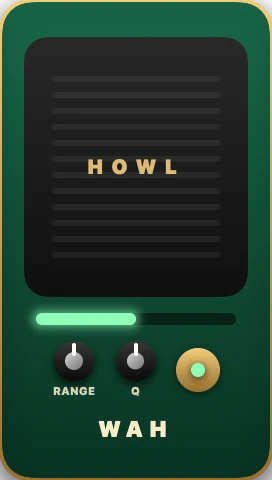
A wah boosts a narrow band of frequencies and moves it from low to high: the sound goes from “oo” to “ah”, like a voice. In UnitBasse it’s an automatic wah: it sweeps on its own, in time, with no pedal under your foot.
What it does to your sound
A wah is a resonant filter: instead of cutting frequencies, it boosts a narrow band and pushes the rest into the background. As that band moves up, the sound opens; as it moves down, the sound closes. Your ear hears a changing vowel, “oo-ah”, hence the name.
There are three ways to move that filter:
- with your foot, on a rocker pedal: that’s the classic wah;
- with an oscillator that sweeps it on its own at a set speed: that’s the auto-wah, the one in UnitBasse;
- with how hard you pluck: that’s the envelope filter, which has its own page.
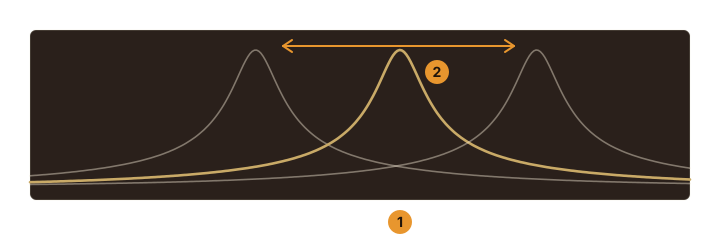
- The filter’s hump: the band of frequencies that gets boosted. The higher the Q, the narrower it is.
- The sweep from low to high and back, at the speed set by RATE; RANGE decides how far it goes.
What it’s for on bass
- ’70s funk and soul: a steady sweep locked to the tempo.
- A line that moves without you changing how you play: the filter creates the movement for you.
- A nasal color, with a slow sweep, for a melody or a bridge.
The controls, one by one
RATE speed · 0.2 to 6 Hz in UnitBasse
The speed of the sweep, in round trips per second. Slow, a stretched-out vowel; fast, a wobble. Lock it to the tempo of the song.
RANGE reach · 0 to 100 %
How high the filter goes. In UnitBasse it starts at 350 Hz and can climb as high as 2,200 Hz. A short range stays dark; a wide range opens up into the highs.
Q resonance · 0 to 100 %
The width of the boosted band. Low, a gentle effect; high, a very pronounced “wah”, almost a squawk.
A starting point
- Set RANGE and Q to halfway.
- Set RATE so that one round trip lands on a quarter note or a half note of the song.
- Fine-tune RANGE and Q by ear: wider and sharper for a strong effect, narrower and softer for a touch of color.
The pitfalls
- A sweep out of time: an auto-wah that doesn’t land in time sounds wrong. Lock RATE to the song.
- Lows that fade back: by boosting a narrow band, the wah pushes the lows into the background. Keep Q moderate.
- Ear fatigue: a very high Q and a fast sweep tire the ear quickly. Use it sparingly.
Where to put it in the chain
Early on, after the compressor, the octaver and the synth, before the envelope filter and the drive pedals: drive after the wah brings out its sweep. That’s its place in the classic order.
In UnitBasse
The wah is called Wah, nicknamed Howl, in the Filter family, alongside the Envelope Filter. It’s an auto-wah: it sweeps on its own. Its display shows the Filter response, with the frequency at the center of the sweep. No factory preset uses it.
Frequently asked questions
Wah, auto-wah or envelope filter?
All three move the same kind of filter. A classic wah is worked with your foot, an auto-wah sweeps on its own at a set speed, and an envelope filter follows how hard you pluck. The one in UnitBasse is an auto-wah.
How do I lock the wah to the tempo?
Play along with the song, or with the metronome, and adjust RATE until one round trip of the filter lands on a quarter note or a half note.
Why does my bass lose low end with the wah?
Because the wah boosts a narrow band, often in the mids, and pushes the rest into the background. Lower the Q, or shorten the range.