 UnitBasse
Effects · Reverb
Reverb for bass:
putting your sound in a room
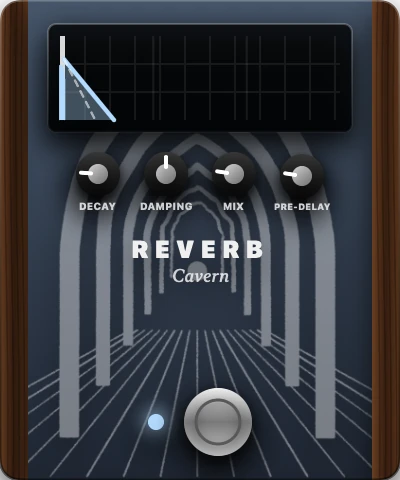
A reverb imitates the sound bouncing off the walls of a room: the note is followed by a tail that fades away. On bass, a very small amount is enough: too much and the low end drowns. Used sparingly, it adds space and depth.
What it does to your sound
In a room, sound doesn’t just reach you in a straight line: it bounces off the walls, the floor and the ceiling, thousands of times. These reflections arrive so fast and in such numbers that you don’t hear separate echoes, but a continuous tail that slowly fades.
Its duration tells you the size of the room: a bedroom, a club, a church. Soft walls, curtains and the audience soak up the highs: that’s damping. And the time between the note and the start of the tail, the pre-delay, gives a sense of distance.
The low end of a bass is long and powerful, and so is its reverb. That’s why a bass handles much less reverb than a voice or a guitar.
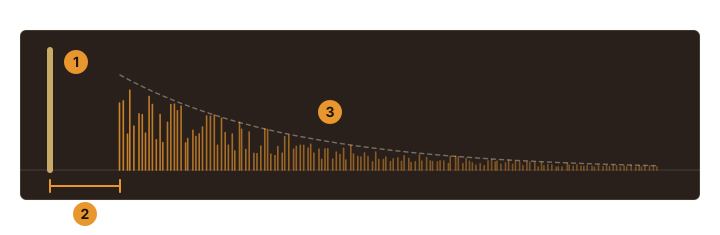
- The note.
- The pre-delay (PRE-DELAY): a short silence before the tail.
- The tail, thousands of reflections fading away: its length is the DECAY.
What it’s for on bass
- Adding space to a bass played on its own, or on headphones, where the dry sound feels flat.
- Dub: with a delay, a bass that rings out in space.
- Ambient textures and intros, long notes and harmonics.
- Fretless and singing lines, with a subtle touch.
The controls, one by one
DECAY the duration · 0.1 to 5 s in UnitBasse
How long the tail takes to fade: short, a small room; long, a big hall. On bass, keep it on the short side.
DAMPING the damping · 0 to 100 %
Softens the highs in the tail. High, a room with soft walls, a dark and discreet reverb; low, a tiled room, bright.
MIX the blend · 0 to 100 %
The level of the tail against your note. The most important control: on bass, keep it low.
PRE-DELAY the pre-delay · 0 to 100 ms
The time before the tail starts. A few tens of milliseconds separate the attack from the reverb: the note stays clean, the room comes after.
A starting point
- Set MIX low, around 15 %, and DECAY around one second.
- Turn DAMPING past the middle, for a soft tail.
- Add a little PRE-DELAY, 20 to 30 ms, to keep the attack clean.
- Switch it on and off: you should feel the space more than hear it.
For comparison, the UnitBasse Dub factory preset sets its Reverb to DECAY 1.5 s, DAMPING 50 % and MIX 30 %, after a Delay: a generous setting, for a style that wants space.
The pitfalls
- Drowned lows: too much MIX or DECAY and the bass loses its definition. That’s the number one trap.
- A groove that fades: the gaps between the notes fill up, and the line loses its bounce.
- Double reverb: in the studio or on stage, the room or the mix already adds some. Save it for headphone practice or a deliberate effect.
Where to put it in the chain
At the very end, after the delay, just before the EQ and the cab: it places everything that comes before it in the room. That’s its place in the classic order. A drive after it would distort the tail.
In UnitBasse
The reverb is called Reverb, nicknamed Cavern, in the Time family, along with the Delay. Its screen draws the Reverb tail: you see how long it lasts and how it fades. You’ll find it in the Dub factory preset.
Frequently asked questions
Should you put reverb on a bass?
Rarely much. A little adds space when you play alone or on headphones; in a band, the room and the mix often bring enough.
Why does my bass get blurry with reverb?
Reverberated low end lasts a long time and blends into the following notes. Lower the MIX and the DECAY, and add a little PRE-DELAY.
Reverb before or after the delay?
Usually after: the delay’s repeats are placed in the same room as the note. That’s the classic order.