 UnitBasse
Effects · Delay
Delay for bass:
echo without muddying the line
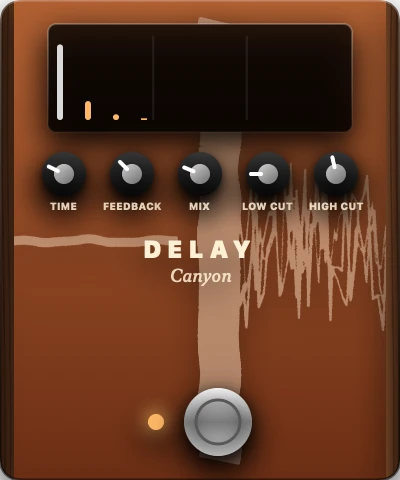
A delay repeats your note after a set time: that’s the echo. Subtle in a bass line, it rules in dub and in solo passages. The secret on bass: cut the low end from the repeats so they don’t muddy the line.
What it does to your sound
A delay records your sound and plays it back after a set time, from a few tens of milliseconds up to a second. Part of that repeat is sent back into the effect: that’s the feedback, which gives you a second repeat, then a third, each one quieter.
When the time is locked to the tempo, the repeats fall in rhythm and become part of the groove. Short, around 80 to 120 ms, you get a quick, slightly vintage slapback. Long, it fills the space.
On bass, every repeat plays the low end again. Since the next note is already sitting there, the bottom of your sound gets muddy fast. That’s why you filter the repeats.
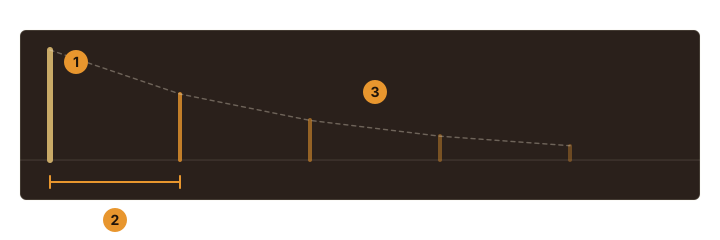
- The note you play.
- The time between two repeats (TIME).
- Each repeat is quieter than the one before: FEEDBACK decides by how much.
What it’s for on bass
- Dub and reggae: long notes ringing out in space, with clearly audible repeats.
- Solo passages, intros, endings.
- A short echo that thickens a line without sounding like an echo.
- Ambient textures, together with the creative effects and reverb.
The controls, one by one
TIME the delay time · 50 to 1,000 ms in UnitBasse
How long before the repeat. To lock it to the tempo: 60,000 divided by the tempo gives you a quarter note in milliseconds. At 120 BPM, a quarter note is 500 ms, an eighth note 250 ms.
FEEDBACK the repeats · 0 to 90 %
How much of the repeat is sent back into the effect. Low, a single repeat; high, a long trail of repeats.
MIX the blend · 0 to 100 %
The level of the repeats against your note.
LOW CUT low cut · 20 to 500 Hz
Takes the low end out of the repeats. This is the key control on bass: the note keeps its low end, the repeats stay light.
HIGH CUT high cut · 1,000 to 12,000 Hz
Takes the highs out of the repeats. Low, a dark, tape-like echo; high, a clear, precise echo.
A starting point
- Work out the TIME of an eighth note or a quarter note at the song’s tempo.
- Set FEEDBACK around 30 % and MIX around 25 %.
- Raise the LOW CUT until the low end stays clean under the repeats.
- Bring the HIGH CUT down a little if the repeats are too bright.
For comparison, the UnitBasse factory presets: Dub sets its Delay to 350 ms, FEEDBACK 50 % and MIX 30 %, followed by a Reverb; Synthwave to 250 ms, FEEDBACK 30 % and MIX 25 %.
The pitfalls
- Mud: the low repeats pile up on the next note. Raise the LOW CUT.
- Off the beat: a time that doesn’t fall in rhythm blurs the groove. Work it out, or set it by ear.
- Too much feedback: the repeats never stop and cover everything.
- Delay everywhere: in a busy bass line, it blurs things. Save it for the parts that breathe.
Where to put it in the chain
Near the end, after the drives and the modulations, before the reverb and the EQ. That way it repeats the sound you’ve already shaped; put it before a drive and the repeats themselves get distorted, and everything turns to mush. That’s its place in the classic order.
In UnitBasse
The delay is called Delay, nicknamed Canyon, in the Time family, along with the Reverb. Its screen shows the repeats over three seconds: you see how they’re spaced and how they die away. You’ll find it in the Dub and Synthwave factory presets.
Frequently asked questions
How do I lock the delay to the tempo?
Divide 60,000 by the tempo: you get a quarter note in milliseconds. At 100 BPM, a quarter note is 600 ms, an eighth note 300 ms. Set TIME to one of those values.
Why does my delay make the sound muddy?
Because the repeats play the low end again, and it piles up on the following notes. Raise the LOW CUT to lighten the repeats.
Delay or reverb?
A delay repeats the note, with echoes you can pick out. A reverb imitates a room, with a continuous tail. The two work well together: the UnitBasse Dub preset chains them.