 UnitBasse
Effects · Phaser
Phaser for bass:
a swirling, liquid sweep
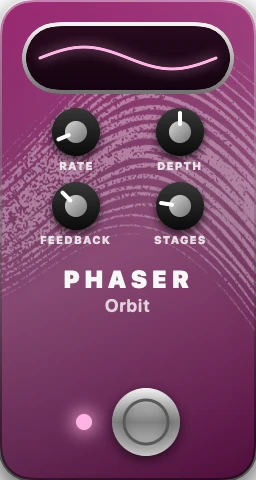
A phaser carves notches into your sound that move slowly: you hear a swirling sweep, soft and liquid. Subtler than a flanger, it adds movement to a line without changing its character. You hear it a lot in funk and ’70s music.
What it does to your sound
A phaser runs a copy of your sound through a series of rather special filters called stages: they don’t change the volume of the frequencies, they shift them in time, each by a different amount. When that copy is mixed back with the original, some frequencies add up and others cancel out.
An oscillator keeps those filters moving: the notches travel across the spectrum, from low to high and back. That movement is what you hear as a swirl.
Each pair of stages adds a notch: the more stages, the richer the sweep. Feedback sends part of the sound back into the effect and makes the notches stronger and more resonant.
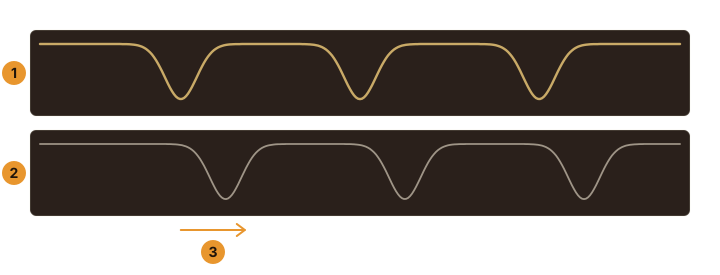
- A few notches: how many depends on STAGES.
- A moment later, they have moved.
- That movement, at the speed set by RATE, is the swirl you hear.
What it’s for on bass
- Funk: a slow sweep that makes an eighth-note line swirl.
- ’70s music, prog rock, jazz-rock.
- Subtle movement, left on almost all the time, on a simple line.
The controls, one by one
RATE speed · 0.1 to 5 Hz in UnitBasse
The speed of the sweep. Slow, the sound breathes; fast, it spins and becomes a strong effect.
DEPTH depth · 0 to 100 %
How far the sweep goes: how much the notches move.
FEEDBACK feedback · 0 to 90 %
Makes the notches stronger and more resonant. Set high, the phaser whistles.
STAGES stages · 2 to 12
The number of stages. Few, a simple, gentle sweep; many, a rich sweep that stands out more.
A starting point
- Set RATE slow, DEPTH to halfway, FEEDBACK low, and 4 STAGES.
- Play an eighth-note line and set RATE so that one cycle lasts one or two bars.
- Raise FEEDBACK and STAGES for a stronger effect.
The pitfalls
- Swirling lows: on very low notes, the movement can weaken your foundation. Keep DEPTH moderate.
- Whistling: too much FEEDBACK gives a high-pitched resonance that wears you out.
- Out of time: a fast sweep unrelated to the song sounds like it’s drifting.
Where to put it in the chain
After the amp and the drive pedals, with the other modulation effects, before the delay and the reverb. That’s its place in the classic order: after the chorus and the flanger, before the tremolo.
In UnitBasse
The phaser is called Phaser, nicknamed Orbit, in the Modulation family. Its display, Oscillator (2 seconds), shows you the speed and the depth of the movement. No factory preset uses it.
Frequently asked questions
Phaser or flanger?
Both sweep the spectrum. The phaser, softer and more liquid, suits movement you leave on all the time; the flanger, metallic and stronger, suits a one-off effect.
How many stages should I choose?
Four, for a classic phaser. Fewer for subtle movement, more for a rich sweep that stands out.
Does a phaser work on bass?
Yes, very well, especially with a moderate DEPTH to keep the low end solid.