 UnitBasse
Effects · Boost
Boost for bass:
more level, no saturation
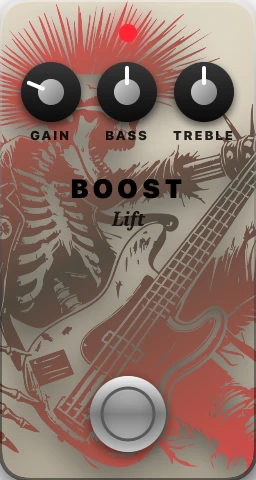
A boost raises the level of the signal without distorting it, or hardly. You use it to make a part stand out, to give more level to a bass with a weak output, or to push the amp into more breakup. It isn’t a drive: the amp breaks up, not the pedal.
What it does to your sound
A boost is a simple amplifier: it multiplies the signal without clipping it. Its level is measured in decibels: +6 dB roughly doubles the signal’s voltage, and sounds clearly louder.
What happens next depends on where it sits. After the amp, it simply turns up the volume. In front of the amp, it sends a hotter signal to its input: the amp works harder and breaks up more. That’s how you make an amp “break up” without a drive pedal.
Some boosts also color the sound. In UnitBasse, it adds a little low end and top end, which you dial in with its two knobs.
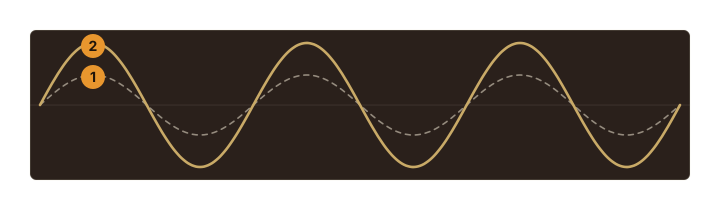
- The signal before the boost.
- The same signal, louder (GAIN), with the same shape.
What it’s for on bass
- A part that has to stand out: a solo, a theme, a break.
- A bass with a weak output, from low-output pickups, to get back to a normal level.
- Pushing the amp: in front of an amp that’s already breaking up slightly, it makes it growl more.
- A touch of color: a bit more lows and highs, for a fuller sound.
The controls, one by one
GAIN the level · 0 to 24 dB in UnitBasse
How much level it adds. A few decibels are enough to make a part stand out; a lot pushes the amp hard.
BASS the lows · 0 to 100 %
A little extra low end, for weight. Go easy: in front of an amp that’s breaking up, too much low end makes the sound muddy.
TREBLE the highs · 0 to 100 %
A little extra top end, for definition and snap.
A starting point
- Set GAIN to a few decibels, with BASS and TREBLE in the middle.
- Switch the pedal on and off while you play: the part should clearly stand out, without the sound changing character.
- To push the amp, slide the boost in front of it on the pedalboard, and raise the GAIN until you get the grit you want.
For comparison: the UnitBasse Warm factory preset sets its Boost to GAIN 6 dB, BASS 60 % and TREBLE 40 %, after a Compressor, on the Thunder amp with a 1×15 cab.
The pitfalls
- A boost that distorts: if it makes the amp break up when you only wanted more volume, put it after the amp, or lower the GAIN.
- The volume jump: a boost that’s too loud catches everyone off guard, on stage as on headphones. Set it while playing with the band.
- Too much low end: a boost that adds lows in front of a drive makes it muddy.
Where to put it in the chain
In the classic order, it’s the last effect before the amp: it pushes it. That’s the spot that gives the most grit. For a simple volume lift, with no grit, slide it after the amp on the pedalboard.
In UnitBasse
The boost is called Boost, nicknamed Lift, in the Gain family, along with the Overdrive, the Distortion and the Fuzz. Its screen draws the Saturation curve: you see it stays almost straight, a sign that it doesn’t distort. You’ll find it in the Warm factory preset.
Frequently asked questions
What’s the difference between a boost and a drive?
A boost raises the level without changing the shape of the sound; a drive reshapes the wave and adds grit. But a boost in front of an amp can make it break up: then it’s the amp making the grit.
Do I need a boost on bass?
It’s not essential. It’s mostly useful for a part that has to stand out, or for a bass with a weak output. The volume knob on your bass or the amp’s MASTER do part of the job.
Boost before or after the amp?
Before, it pushes the amp and adds grit; after, it turns up the volume without changing the sound at all. Pick the one that fits what you’re after.