 UnitBasse
Basics · 5-string
Switching to 5-string bass:
what really changes
A 5-string adds a low B string below the E. Everything else is the same as on a 4-string, because the tuning stays in fourths: scale and chord shapes don’t change. You gain lower notes, and room to play longer without shifting position. In return: one more string to mute, and a wider neck.
The tuning
From low to high: B, E, A, D, G. The low B vibrates at about 30.9 Hz, a fourth below the E, which vibrates at about 41.2 Hz.
The shapes stay the same
From B to E is a fourth, just like E to A, A to D, and D to G. So a scale, an arpeggio or a chord is played with the same shape from the B string as from the others.
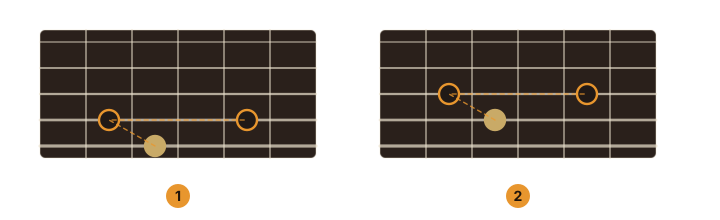
- From the B string.
- From the E string: the shape is identical, one string higher.
Don’t confuse this with guitar, where the B string breaks the tuning in fourths. On a 5-string bass tuned B-E-A-D-G, nothing shifts.
What you gain
- The notes below low E: D, C♯, C, B. Keys like D, C and B get their real low root.
- Playing in position: notes that needed a big shift on a 4-string are right under your hand, one string lower.
- An extra register for the styles that love it: metal, gospel, modern pop, electronic music.
What takes work
- Muting: one more string to keep quiet. Your plucking-hand thumb moves with your hand, from string to string: this is called a floating thumb.
- A wider neck, which is a bit more tiring at first.
- Finding your way: for the first few weeks, you’ll land on the wrong string.
- Taste: the low B fills up a mix fast. Play it when it adds something.
The gear
- An amp and a cab that go low enough, or the low B will barely come through, or will rattle the furniture.
- Enough string tension, often with a slightly longer scale, so the B doesn’t feel floppy.
How to get started
- First play your usual lines without touching the B, while learning to mute it.
- Then use it to avoid a shift: the note is often right there, one string lower.
- Finally, use it as a note in its own right, to go below the E.
What about the 6-string?
It adds a high C string above the G, still a fourth up. It’s mostly used for chordal playing and solos.
With UnitBasse
The 5-String tuning (B-E-A-D-G) is in the Tuner, with its TUNING setting, and in the Scales tab: there, the fretboard shows the 69 scales on five strings, with fingerings. BackTrack offers it too. And Scores writes for 4 or 5 strings, and even for a 5-string with a high C, or a 6-string.

Frequently asked questions
Is a 5-string harder?
A little at first: the neck is wider, and there’s one more string to mute. But the shapes are the same as on a 4-string, and you get used to it in a few weeks.
Do I need a special amp for a 5-string?
You need an amp and a cab that go low enough for the low B. A small practice amp reproduces it poorly, but it works. On headphones, the low end comes through well.
How do I tune a 5-string bass?
B, E, A, D, G, from low to high. You tune the B like the others, with a tuner: it vibrates at around 30.9 Hz.
Can I start on a 5-string?
Yes, if that’s the sound you love. But a 4-string makes it easier to learn muting and to find your way around. Moving to a 5-string later is easy.