 UnitBasse
Tips · Setup
Setting up your bass:
action, neck relief and intonation
A well set-up bass takes less effort to play and plays in tune all over the neck. Four adjustments, in order: neck relief, action, intonation, pickup height. When in doubt, especially with the neck, see a luthier.
Signs of a poor setup
- The strings buzz: they hit the frets as they vibrate.
- The strings are too high, and hard to press down.
- Notes are out of tune higher up the neck, even though the open strings are in tune.
Before you start
New or clean strings, a bass tuned up properly, and the bass held the way you play it. Each adjustment slightly affects the others: stick to the order, and retune after every step.
1. Neck relief
A neck isn’t perfectly straight: it has a slight forward bow, to give the strings room to vibrate. A metal rod inside it, the truss rod, sets that bow.
To check it: fret the E string at the first fret and at the last fret, and look at the gap between the string and the frets in the middle. It should be very small, about the thickness of a business card.
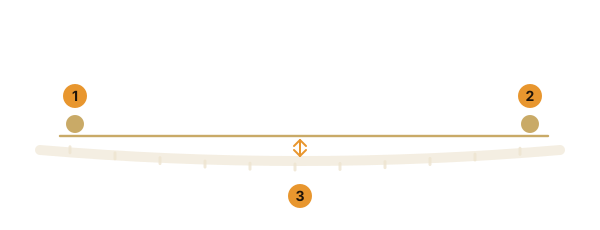
- Fret the string at the first fret.
- And at the last fret.
- The gap in the middle: the thickness of a business card.
To adjust it: a quarter turn at most at a time, then let the neck settle for a few hours before you check again. Tightening straightens the neck, loosening adds relief.
Never force it. A truss rod that won’t turn is a job for a luthier: a damaged neck is expensive.
2. Action
Action is set at the bridge, string by string, and measured above the 12th fret. A common starting point is about 2 to 2.5 mm on the bass side and 1.5 to 2 mm on the treble side.

- The string.
- The gap to measure, above the fret.
Lower, the bass is easier to play but buzzes more; higher, it stops buzzing but takes more effort. Everyone finds their own balance, depending on how hard they play.
3. Intonation
The note at the 12th fret should be exactly one octave above the open string. Compare it with the 12th-fret harmonic (your finger touches the string lightly right above the fret, without pressing), or with the open string.
- If the fretted note is sharp, move that string’s saddle back, away from the neck.
- If it’s flat, move the saddle forward, toward the neck.
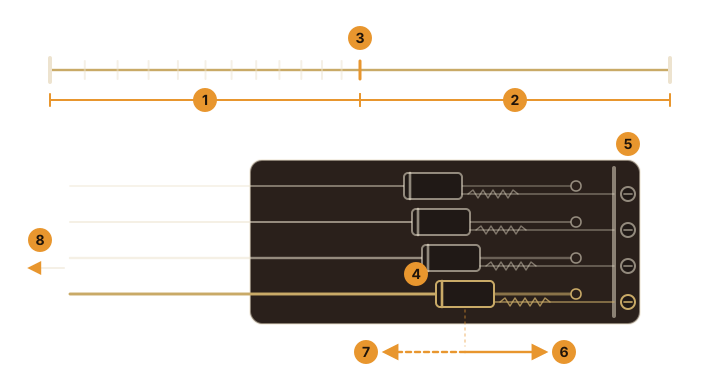
- From the nut to the 12th fret: half the string.
- From the 12th fret to the saddle: the other half. Both must be equal for fret 12 to give an exact octave.
- The 12th fret.
- The E-string saddle. The saddles are staggered: the low strings need a little more length.
- The adjustment screw, at the back of the bridge: turning it moves the saddle.
- Move the saddle back, away from the neck: the note at the 12th fret goes down.
- Move it forward, toward the neck: the note goes up.
- The neck side.
String by string, retuning each time.
4. Pickup height
Close enough to the strings for volume, far enough that the magnets don’t pull on the strings, which throws notes out of tune and cuts their sustain. The low strings, which vibrate wider, are usually set a little farther away.
When to see a luthier
- A truss rod that won’t turn, or a neck that won’t straighten.
- Worn, grooved or uneven frets: the bass buzzes on certain frets only.
- A seized bridge, or screws that won’t turn anymore.
A good setup from a luthier often transforms an entry-level bass.
With UnitBasse
The UnitBasse Tuner, in STROBE mode, is accurate to within one cent: the bands stop moving when the note is in tune. It’s the tool you want for intonation: the note at the 12th fret should give the same note as the open string, with no offset. Keep the REFERENCE at 440 Hz while you set up: a double-click brings it back there.
Frequently asked questions
My bass buzzes. What should I do?
Check neck relief first, then action. If it only buzzes on certain frets, the frets themselves may be the problem: a luthier can level them.
How do I know if my neck is straight?
Fret the E string at the first and last frets, and look at the gap in the middle. It should be very small, about the thickness of a business card.
How high should my action be?
A common starting point is 2 to 2.5 mm on the bass side and 1.5 to 2 mm on the treble side, measured at the 12th fret. Then adjust to suit how hard you play.
Should I change strings before a setup?
It’s better: worn strings sound out of tune and throw off your intonation. Always set up with the strings you’re going to play.